blog

Florida’s Lonely Attractions

Roadside stands like the one pictured above are fairly common along freeway exits in Florida.  This outdoor display invites travelers to pick up a bag of oranges for loved ones up north who may be digging out from a snowstorm.  Today people can buy citrus at any grocery store year round, so purchasing oranges may no longer be a novelty.  This business expanded it’s inventory by selling Georgia pecans, citrus wine, gator jerky, and fireworks. I admire the creativity of Florida entrepreneurs who work hard to keep their businesses alive.

Tourism has a long history in Florida. I’m amazed so many of the older attractions are still open. Today most tourists spend their entire vacations at Disney or Universal Studios. They miss out on the unique attractions which preserve Florida’s past.

IMG_7751 (2)

The Citrus Tower in Clermont opened in 1956 as a tribute to Central Florida’s citrus industry. Did you know Central Florida once had a booming citrus industry? No one would know it today. Neighborhoods and roads have replaced miles of fragrant orange groves.

The tower is located on one of the highest hills in central Florida, a whopping 128 feet above sea level.  The structure rises 226 feet and was constructed of concrete and reinforced steel to withstand hurricane force winds. I entered the elevator for the scary ride up twenty-two stories in total darkness with no air conditioning. Who needs the Tower of Terror?

When the door opened I stepped out onto a glass enclosed observation deck and walked around. I could see the rolling hills, spring-fed lakes, roads, and parking lots, but no orange groves.

IMG_7722 (1)

I wish I could have been here in the old days when citrus was king.

IMG_7742 (5)

This is an artist’s view of the land surrounding the Citrus Tower during the 1950’s. The hard freezes of the 1980’s killed the orange trees. Growers sold their land in the Clermont area to real estate developers. I enjoyed reading the historical information outside the gift shop located in the base of the tower. Back in the day, the attraction included a restaurant. A menu from the past was posted in a display case. I couldn’t believe the price of a sizzling T-bone steak with onion rings was $3.50.

The Citrus Tower offers a  light show during the Christmas season and is open evenings in December. The view from the observation tower is reported to be spectacular at night. Click on the above link for more information and reviews.

IMG_7753 (1)If you visit the Citrus Tower be sure to see the President’s Hall of Fame next door. Ronald Reagan described this museum as a national treasure for over forty years. The Hall of Fame features one of a kind presidential memorabilia.

IMG_7749

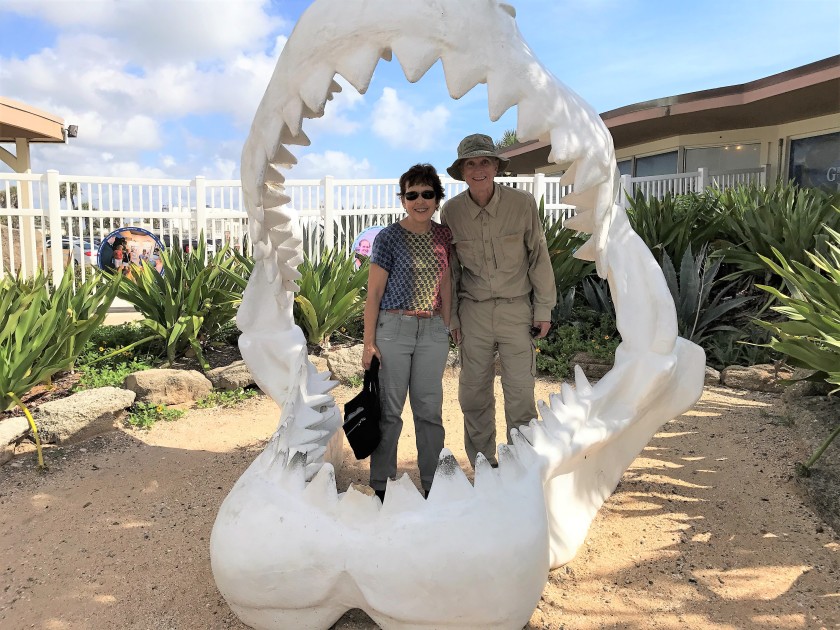
Here’s an interesting photo spot. Where did they get that idea?

Stay tuned for more lonely Florida attractions next week.  A side of Florida few people see, and more should.


Nature’s Classroom at Faver-Dykes State Park

Camping during the Florida summer is not for wimps. Our trip to Faver-Dykes State Park challenged us in ways we have never been challenged before. Located in a remote area fifteen miles outside Saint Augustine, the park is known for being “off the beaten track.” We pulled our Viking trailer over the bumpy dirt road to the entrance of a small campground. As the campsite was not level, my husband, Herb made several attempts before he successfully parked our trailer in the soft sand. Soon a park vehicle stopped nearby and a ranger stepped out to welcome us. The ranger took an interest in our dog, Buddy, the best beagle ever.

Faver-Dykes Trip 028

Early the next morning we decided to hike the 2.6 mile Hiram-Faver Trail. Guess what? The trail was named in honor of Hiram Faver, who donated the land to the state for a park. Go figure!  On our way to the trailhead we walked by the park office. The friendly ranger who  welcomed us yesterday came out of the office to say hello. He asked where we were headed. I told him the Hiram-Faver trail. “Oh,” he said, “you better watch out for ticks out there.”

“We’re prepared, ” I boasted. I wore long sleeves and long pants and tucked my pantlegs into my socks. I also sprayed my legs with bug spray. The ranger focused his attention on Buddy. “I always put a tick collar on my dog. Then the ticks never bother him.” Suddenly I realized that Mr. Ranger was more concerned about Buddy than we were.

“Buddy is on special medication to prevent ticks from harming him,” Herb responded. At the time I wondered, how bad can it be out there?

Faver-Dykes Trip 063

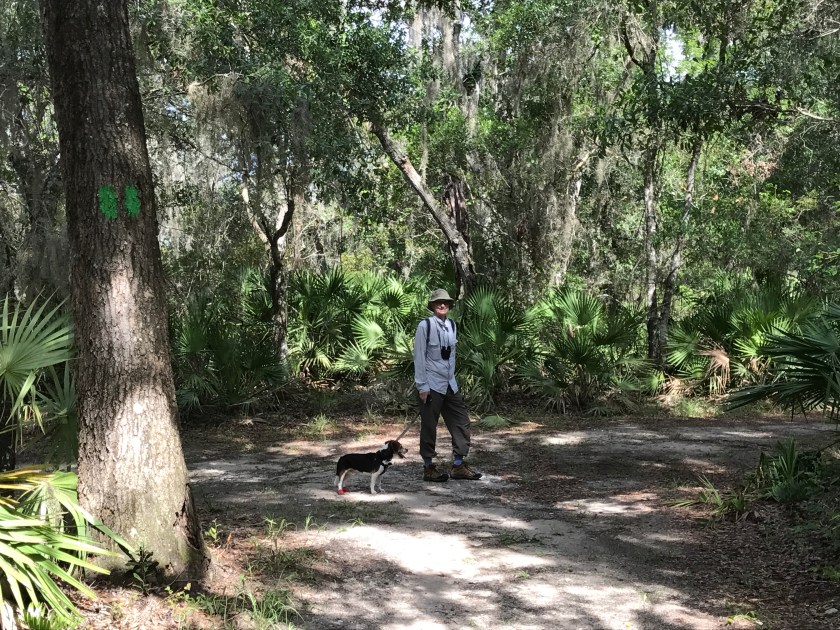
We began hiking with Buddy in the lead. July is hot in Florida. Herb and I kid each other that real Floridians can handle the heat. But we forget that we aren’t real Floridians. We’re actually transplanted Buckeyes from Ohio, and Buddy hails from North Carolina.

Faver-Dykes Trip 053

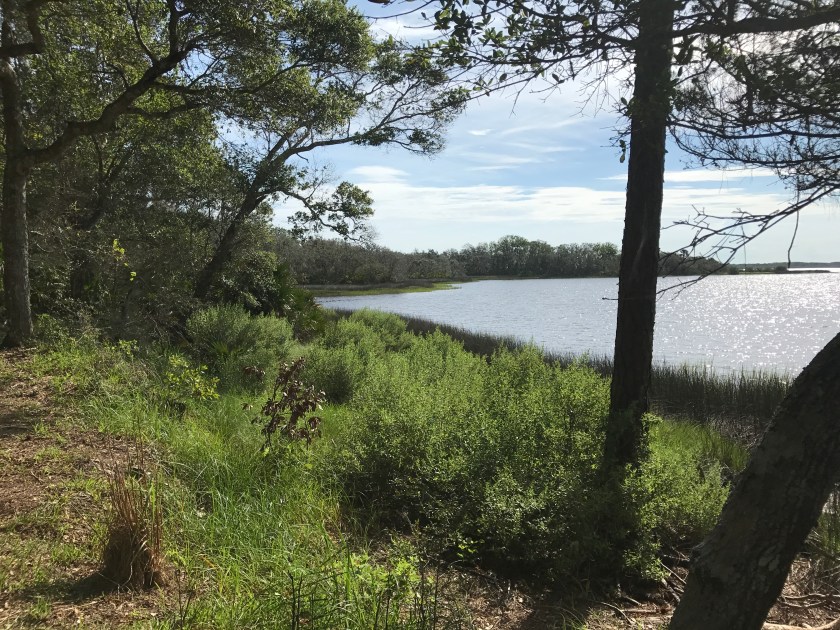
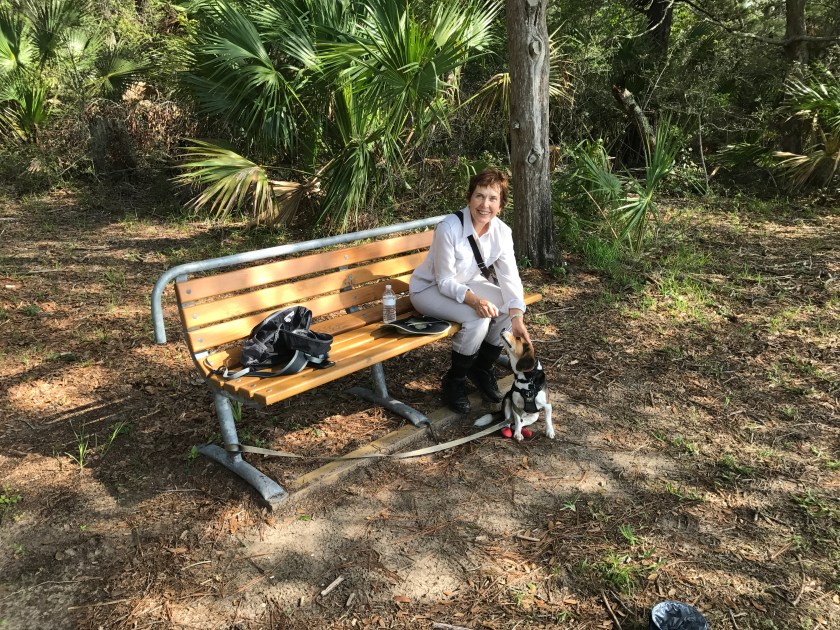
As we approached Pellicer Creek, we felt a delightful cool breeze off the water. We saw a bench and sat down to enjoy our granola bars and bottled water. Buddy had a drink, too, and relaxed in the grassy area at our feet.

Faver-Dykes Trip 056

I took out my cell phone to take pictures.  I noticed I had phone service. (Something not always available at the campsite.)  Herb looked across the river and spotted a cell tower. What luck! We had a great time sitting on the bench, texting pictures and checking our email. I even posted a couple of photos on Facebook.

After about twenty minutes, I noticed something crawling on the front of my shirt. “A tick!” I yelled. Herb rushed over and brushed it off. Then I spotted a tick on his pants. I brushed it off him. “Let’s get out of here.”

We hiked back toward the campsite. I still wasn’t very worried. So we saw two ticks. Big deal. We’re only a mile from the campsite. All will be well.

When we reached the campsite, we sat on the ground with Buddy and examined his belly. I lost count of the numerous ticks attached to his legs and stomach. I felt terrible. What did I do to my dog?

I grabbed the tweezers from the first aid kit and Herb and I combed through his fur with our fingers. It wasn’t easy to remove the ticks from Buddy’s skin. They were small, brown, shiny, and wanted to stay put. When I pulled the first tick out I didn’t know what to do with it. It latched on to the tweezers and wouldn’t let go. Then it started to crawl onto my hand. Yikes!

Finally I got the idea of dropping the live tick in a cup of water. It worked. I removed at least thirty ticks from Buddy. We covered the cup with a second smaller inverted cup to keep the ticks from crawling out. If possible, we wanted to keep them out of our campsite. We wrapped the tick filled cup in a plastic bag and dropped it in the nearest garbage can. Hopefully they didn’t escape.

Buddy was a trooper. He didn’t complain, and relished all the attention. Ticks are strange. Unlike other pests, you don’t feel it when they dig in to your skin. No sting, no itch. Unless you check yourself and your family from front to back and head to toe, you don’t know you have them.  I know, I removed three from my ankles.

Hikers beware! July is peak season for ticks in Florida. Nature has many lessons to teach, but we will not attend the July session of the school of ticks again.


The Attack of the Killer Snails

Recently I planted twenty pretty pink vincas.  Since the summer rains returned to Orlando, I thought my new flowers would do well. Little did I know the rain activated a hungry army of garden snails. When my trowel scraped through the soft soil it was like a dinner bell announcing, “Come and get it. Dinner is served.”

IMG_9704

Snails like to feast on plants during the dark of night. When morning arrives they take cover under the soil. The day after I planted the flowers I noticed some sawed off leaves lying near the base of several stems.  Oh no, I thought.  How can I stop the snails from destroying my garden?

I remember the snail war of 2015. That year I introduced a successful tactical weapon.  SNAIL BAIT!  I don’t like to use snail bait because of our beagle. Although the label on the package explained the product was safe for pets, Buddy nibbled on some of the pellets and became ill. At the time I was so scared I made an appointment for Buddy to be examined by our vet.  Upon receiving the results of his blood test, the doctor informed me Buddy was alright. However, he suggested I discontinue the use of snail bait in my garden.

Back to the battle at hand. My mom suggested I put broken eggshells around each plant. The snails hate walking on the sharp edges, and leave. I ate two eggs for lunch to build up my artillery.  Still, two eggshells couldn’t begin to defend twenty plants.  An avid gardener herself, Mom sympathized and donated a few more eggshells to the war cause.

My brother offered another idea. “How about fireplace ashes? I heard they keep slugs away, maybe they’ll work for snails.” I liked his idea because I still had some ashes in our patio fireplace that we burned last winter.  Besides, I didn’t really want to eat more eggs. I carefully ringed each plant with ashes to build up my fortifications before another nighttime attack would ensue.

The next morning I rushed out to the patio to check on my plants. Let’s put it this way. If I was keeping score it would be Snails: three / Debbie: seventeen. (Remember, I started with twenty.) Sadly, I carried three vinca casualties off the battlefield.

Desperate, I sought advice from the internet. When I searched “snails” a number of links came up. I watched a YouTube video which explained how to harvest garden snails and eat them. Yuck! In the video a man gathered the snails and boiled them in beer. Then he removed the shells and sautéed them in garlic butter. I want to kill my enemies, but I don’t want to eat them.

During my research I learned snails breathe air. If sealed in a zip lock bag the snails will suffocate. That’s a good plan as long as a person can get up early enough to pick the slimy pests off the plants before they retreat into their underground tunnels for the day.

I’d also heard of setting out little saucers of beer to drown the snails. That idea seemed hit or miss. With my luck the snails would feast on the flowers before they belly up to the bar! All of these methods took too much time.  I wanted a solution now.

Yep, you guessed it. I chose the nuclear option. I drove to Home Depot for a box of snail bait and quickly placed the pellets around each suffering vinca before nightfall. The box was labeled non toxic and safe for wildlife. The snails eat the bait, stop feeding on the plants, and crawl away to die.

But what about Buddy?  Suddenly  I realized  I could keep our dog away by fencing the area.  I used our patio furniture to build a fence around the bed and filled in the openings with pots. Someone once said, “necessity is the mother of invention.”

IMG_9728

This morning I surveyed my brave vinca troops. Snails: zero /  Debbie: seventeen.

The Folk Art of the Suwannee River

When Stephen Foster wrote the song Old Folks at Home there was no music business as we know it. Sound recording had not been invented. Yet, in the small community of White Springs Florida, a state park is dedicated to his memory.  All because Foster  looked on a map for the name of a southern river which had two syllables. He had never seen the Suwannee River, but he liked the sound of the name and changed the spelling to “Swannee” to make the meter work. How’s that for poetic license?

IMG_6519Last week my husband and I camped at the Stephen Foster Cultural Center State Park . It was founded as a memorial to Stephen Foster due to its location on the Suwannee River. (Remember, the river that Stephen Foster never saw, but wrote a song about?)

IMG_9544The Florida Federation of Music Clubs admired Foster and obtained contributions of land in White Springs.  Later a commission  formed to direct the building of a 97-bell carillon on  property which plays Foster’s music. The park opened in 1950, almost one hundred years after Old Folks at Home was published. Did you know Stephen Foster is considered the pioneer of American pop music? He wrote two hundred songs between 1850 and 1864.  Old Susanna and Camptown Races  are two of my favorites.  These melodies are catchy. Once you start humming them, you can’t stop!

IMG_9556During our stay we learned of the park’s mission to support folk art. What is folk art? Art that’s created by nonprofessionals.  In America, folk art might be considered blue-collar or rural art. It can be self taught, and is often functional. Quilting, sewing, and knitting are all examples of folk art.  Folk art also includes music which expresses a community’s values and identity. At the park I enjoyed meeting several folk artists who demonstrate their talent in the Craft Square.
IMG_9545

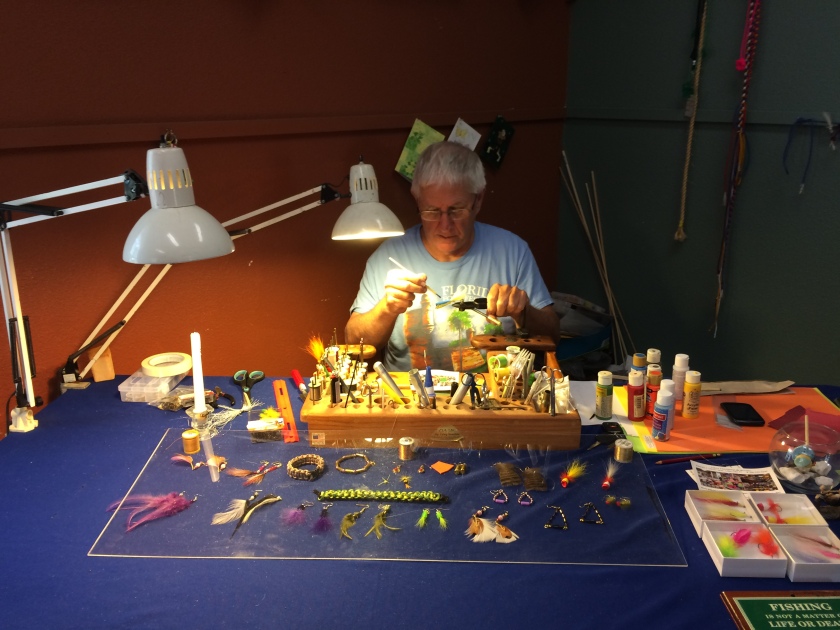
Richard Darlington, a resident of White Springs, creates affordable earings and flies for serious fishermen.

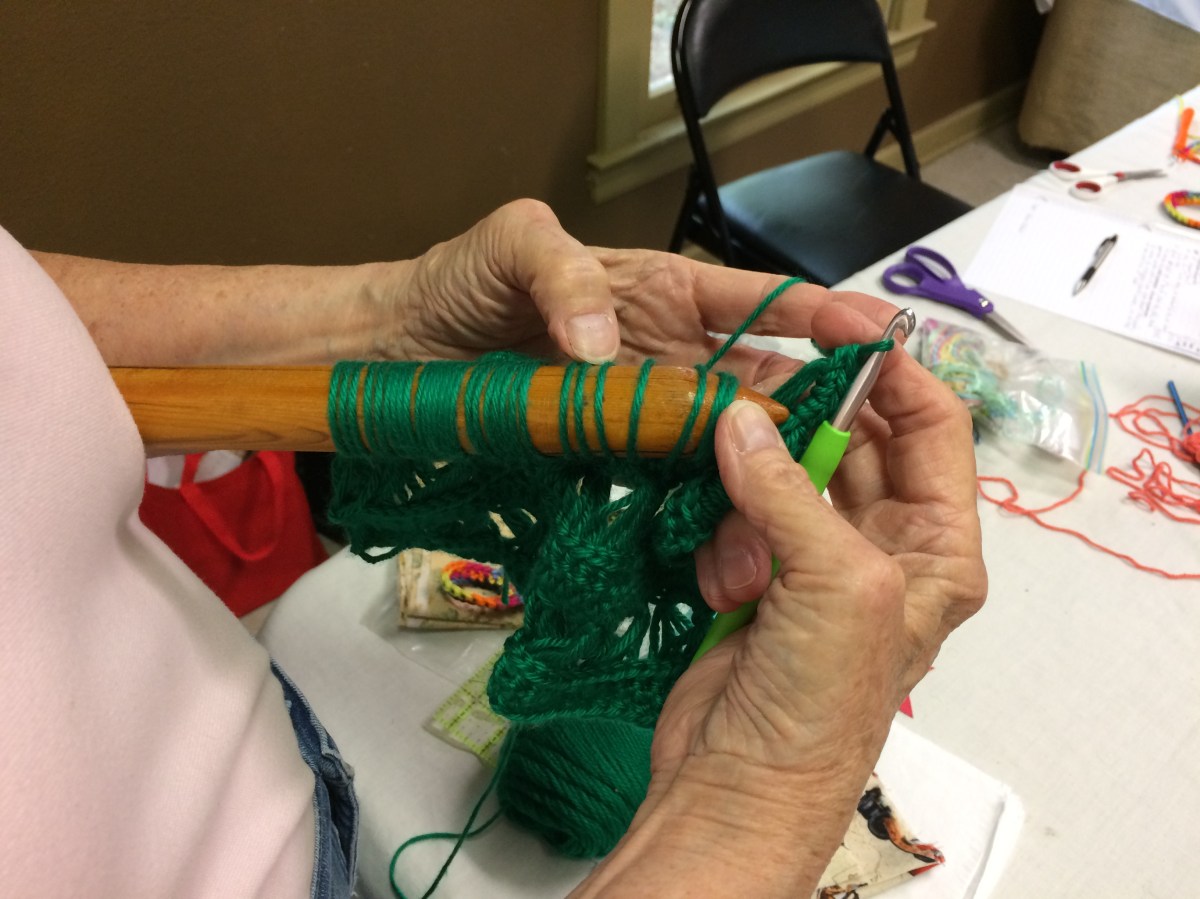
IMG_9548Chris Jacobs from Miami crochets broomstick lace which can be worn as a scarf.

IMG_9551Marie Longo sews baby quilts for the Pregnancy Care Center of White Springs.
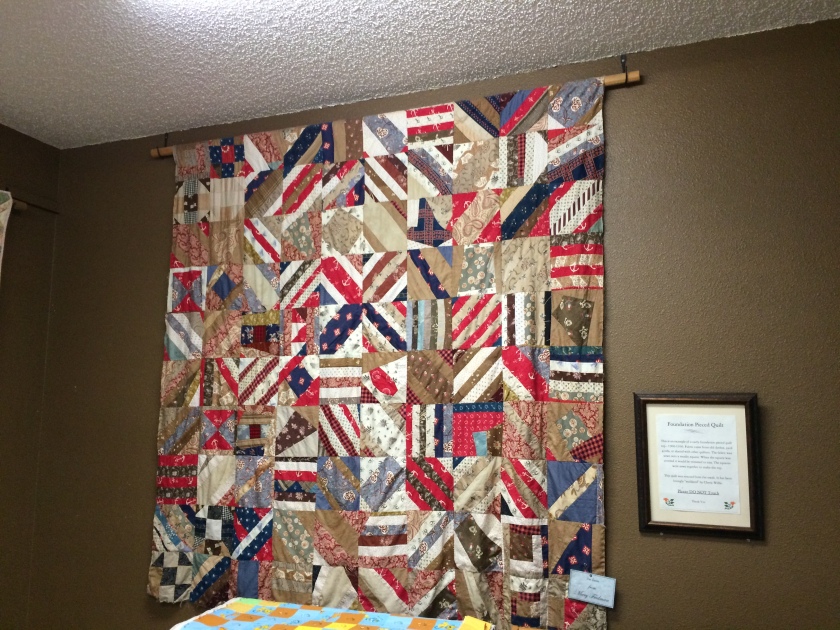
IMG_9552A quilt top hangs on the wall of the fabric arts cottage.  Someone rescued it from a dumpster in Live Oak.  This quilt top was sewn from remnants of old clothing thought to be over one hundred years old.
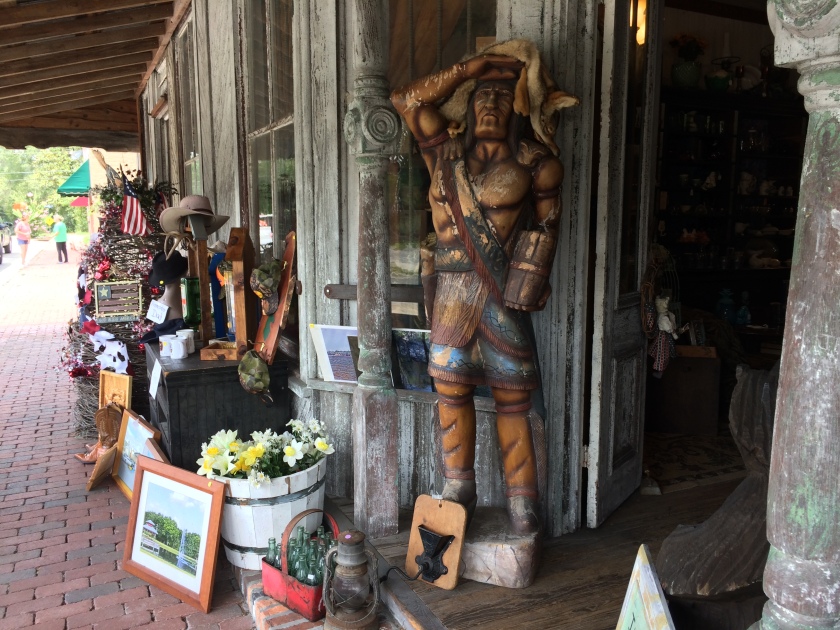
Antique shops are a great place for folk art.  The Adams General Store in nearby White Springs is worth seeing. Built in 1865, the building contains unbelievable finds. But go early, due to a lack of air conditioning.

IMG_9679

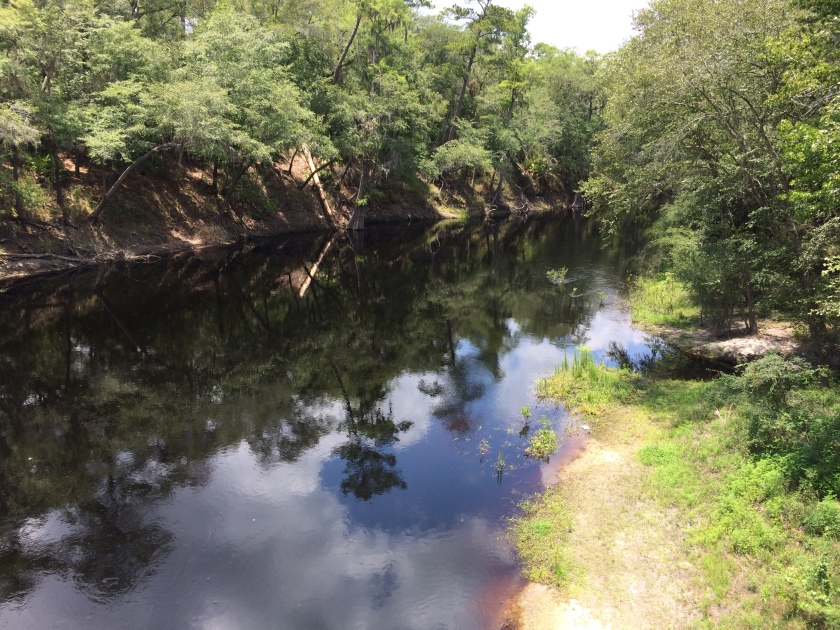
I can’t conclude this post without some mention of the Suwannee River. Unlike Foster, I did see it.

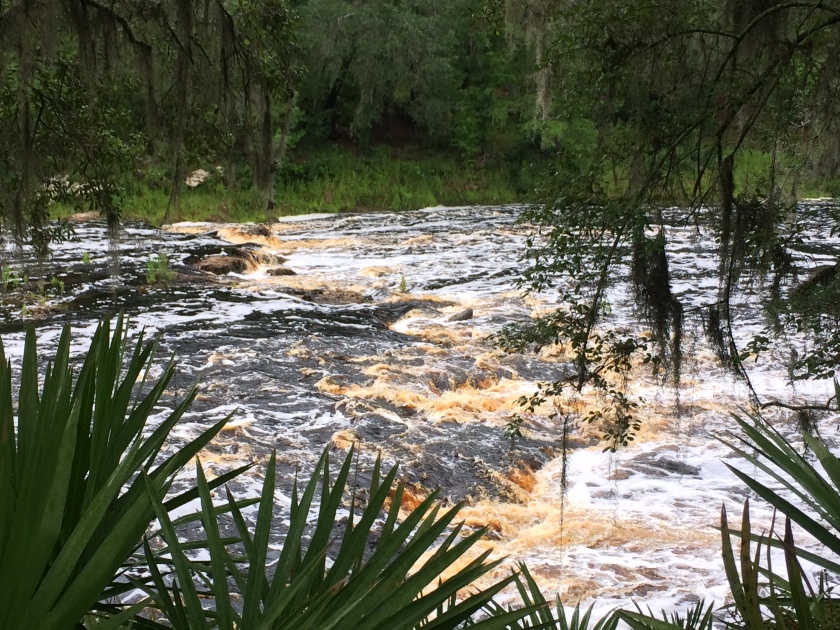
330The Suwannee is considered a black water river. Originating in Georgia, the river flows south through forested swamps. Decayed vegetation stains the water the color of coffee.  At Big Shoals, located outside of White Springs, a nine foot drop in elevation creates class three rapids. Here, the natural brown color of the water is more evident.
270

At age 37 Stephen Foster experienced a persistent fever which resulted in his death. He died in 1864 with thirty-eight cents to his name.  And like the deep Suwannee River, Stephen Foster’s melodies live on today.


The Gem of Winter Park

One of my favorite places to visit is the Morse Museum of Winter Park, Florida.  The Morse Museum contains the most comprehensive collection of works by American artist and designer Louis Comfort Tiffany.  Exhibits include leaded-glass lamps, unique windows, and architectural elements from Tiffany’s Long Island estate, Laurelton Hall. My favorite part of the museum is The Chapel which Tiffany created for the Chicago World’s Fair in 1893.

Inside The Chapel, intricate glass mosaic surfaces reflect light from a ten foot by eight foot electrified chandelier in the shape of a cross. Sitting in the chapel makes me feel as if I’m in another world. Similar to the great cathedrals of Europe, The Chapel inspires me to consider the beauty and holiness of God. I am reminded that darkness will never extinguish the light.

Stained glass as an art form reached its height in the Middle Ages. The stained glass windows of medieval churches taught the narrative of the Bible to an illiterate population. During the twelfth century in England the Tree of Jesse Window  displayed the genealogy of Christ. Pictured at the base of the tree is Jesse, father of King David. On higher branches are the kings and prophets of Judah. At the top Christ and Mary are shown. This window shared Isaiah’s prophecy: “And there shall come forth a rod out of the stem of Jesse and a Branch shall grow from his roots.”

As America became more industrialized during the late 1800’s and cities grew, churches sought artists who could work in stained glass.  During the nineteenth century, pot metal glass was commonly used. Craftspeople often painted this regular looking glass with enamels.

Tiffany’s windows took stained glass to a new level. His invention of opalescent glass used chemicals to create the variations of color found in nature. The result was a more realistic looking product.   Tiffany’s windows fulfilled a long-desired American goal of countering the perceived artistic superiority of Europe. He mastered the art, and by 1900 America led the world in the production of stained glass decorations. Tiffany Studios produced a range of products including lamps, pottery and jewelry.

IMG_7605 (2)

Tiffany was inspired by nature and intoxicated by color.  Winter is an example of opalescent glass from the Four Seasons panel on display in the Morse Museum.

BOGO Banter

I like BOGOs.  Every Thursday morning I drop by my neighborhood Publix grocery and pick up their ad.  After lunch  I plan my weekly menu around their special promotions.  Then I check through my coupons to see if something matches a BOGO. On my shopping list, I star those items.  Before leaving for the store, I check my pantry to make sure I don’t already have two or three of any items on my list. This is a very important step. I don’t want to buy two more jars of pickle relish if I have four.  (I had to learn this the hard way!)

Once inside the store, I read the expiration dates on the BOGOs I might not use quickly. For example, mayonnaise isn’t much of a fast mover at our house. On the other hand, cookies disappear quickly.  Meats like chicken, bacon, and hot dogs can be frozen for later use. Canned goods have a long shelf life.  One product I know I will always use is Multi-Grain Cheerios. It’s a healthy, low-calorie cereal that is almost always on sale. I’m ecstatic if dog food is a BOGO. Might as well stock up for the family pet.

BOGOs encourage me to experiment with new foods. Sometimes it’s kind of scary to purchase two of something you’ve never tasted. This year I’ve been introduced to Califia Farms creamers, and Good Thins crackers. If this is a ploy to interest customers in new products, they caught me. Only once did I buy something I didn’t like, and my brother was happy to take it off my hands. In addition, some Publix brand products taste comparable to name brands. Recently I discovered the store brand healthy request soups taste comparable to Campbells.

I reached a shopping zenith during the week of Memorial Day. Between BOGOs and coupons I saved $81.09. I was absolutely giddy as I inserted my credit card into the payment kiosk.  On my way out the door I flaunted my receipt to the assistant manager. He looked surprised, but smiled and congratulated me. He probably thought I was bordering fanaticism.

I’ll admit I don’t always save as much as I did on May 28,  but I’m succeeding to hold my own as food prices rise. Some people say they pay less for food elsewhere, but do they enjoy the experience of shopping as much?  Is the store clean? Is customer service offered?  I appreciate someone ringing up and bagging my groceries. I enjoy chatting with the young people who help me load the car.  Forgive me if I sound like a commercial, but Publix has spoiled me. It’s the store where “shopping is a pleasure.”


Maybe Less Really is More

Somehow I convinced myself I needed a new chair. Did it matter we already have fifteen chairs in the house? Not at all. None of them seemed to suit me anymore. I wanted an easy chair which would give me more back support. I also wanted to be able to elevate my feet. I’m short, and the two big recliners in our family room do not fit me well.

I discussed my dilemma with my husband, Herb. He understood and agreed, but with one condition. Herb wanted me to be “sure” I found the chair comfortable before  the purchase was made.  After all, I was “sure” about the recliners we purchased two years ago.

That’s hard  to determine. How can I know about a chair unless I sit in it for awhile? I wondered how the furniture sales people would react if I brought a book and sat in their showroom for an afternoon.

“I’m just going to look around,” I said as I grabbed my purse and drove off to the nearest Memorial  Day home sale. Believe it or not the store had what I wanted. A comfy easy chair and ottoman which coordinated with the style of our sofa. I called Herb and asked him to meet me in the showroom with a pillow from our sofa so we could match the colors. The salesman informed us we would need to special order the set since we wanted a color change. The order would take about four weeks to fill. With additional charges for a fabric protector and delivery, Herb and I knew we were looking at a major purchase. And did I mention the chair was not on sale?

When I looked at Herb’s face something told me to wait.  I remembered the mistake we almost made about the purchase of our camper. I politely told the salesman I needed more time to think.

The next day our son came to visit. I told him I thought I needed a chair. He looked around the room and said, “I think you have too much furniture in here now. Why don’t you get rid of the coffee table?” The funny thing is I agreed with him. After we carried the table out to the garage, I rearranged the remaining furniture. Now I could place the ottoman from our existing recliner near the sofa. Did I mention I’ve always been comfortable sitting on the sofa? Shazaam! Now I can sit on the sofa and elevate my feet! My furniture dilemma was solved.

I can’t help but get philosophical about this. How many other times have I thought I needed something and ran out to buy it without really thinking? I am not a minimalist, by any means, but I want to be more deliberate about the purchases I make.  I recently watched a documentary about minimalism.  Minimalists rid themselves of excess possessions in order to focus on what’s important. I didn’t need another chair. I needed a different way of arranging my furniture.

Rearranging the furniture also opened possibilities for other changes in the room. I found an accent table, a candle holder, and a picture in an upstairs bedroom.  Voila! I created a new look out of things I already owned.

Anyone need a coffee table?

If Trees Could Talk and Other Poems

This week’s post combines two of my great loves, poetry and travel. Many of our past family vacations included sight-seeing in the western United States. The juniper trees of Canyonlands inspired me to write The Time Trav’ler. This poem received first place in the 2015 Florida Tapestry Contest. A year later The Time Trav’ler was published in Time of Singing , a journal of Christian poetry.

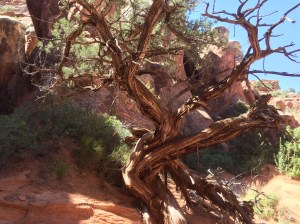
While visiting Canyonlands I learned some juniper trees have lived for a thousand years. Their twisted and gnarled branches survived centuries of harsh winds and extreme changes in temperature.  I was intrigued by a juniper’s half-dead/half-alive appearance. Its dark green foliage sprouted from branches that looked like pieces of driftwood. The tree emitted a sweet fragrance, and delighted my senses as I hiked in the high desert.

Juniper trees do not exceed thirty feet above ground. Two-thirds of the tree grows underground forming an extensive root system in search of water. Somehow a juniper thrives in areas that only receive seven to nine inches of rainfall a year. Junipers are common on the rocky mesa tops and ridges of Utah.

Canyonlands was inhabited two thousand years ago by ancestral Puebloan tribes who farmed maize, beans and squash.  Living in villages similar to those in Mesa Verde, Colorado, the ancient Pueblos carried water from the Green River below to their gardens at the top of the canyon. If a one thousand year old juniper could talk it might tell us what it has seen on its travels through time.  My illustrations for The Time Trav’ler were taken at various locations throughout Utah, Colorado, and Arizona.


The Time Trav’ler   by Debra Burton (2015)

IMG_2769

Old Majestic Juniper

green needles for a crown

saw a thousand years go by

upon this piece of ground.


IMG_3562 (2)

He saw the highland Pueblos

ascend the rocky cliffs

with earthen jars of water

each drop a precious gift.

IMG_5752

Below his dark gray branches

small creatures made their bed

and from his juicy berries

coyotes often fed.


IMG_5856 (2)

Old Juniper heard miners

shout curses at their mules,

encumbered with provisions

and clanging metal tools.


IMG_3444

He heard the wheels of wagons

roll at a steady pace.

Steered by the early settlers

with dangers yet to face.


IMG_3848 (2)

The old tree heard the hoof-beats

of mustangs running free.

Pursued by eager cowboys

in faded dungarees.


IMG_2808

One day his lower branches

were clothed with calico.

A signal for the work crew

which way the trail should go.


IMG_3058

Tourists come to Canyonlands

to see this patriarch,

take photos with their smartphones,

reach out and touch his bark.


IMG_2918

Time trav’ler of the ages

mute watchman of mankind

a sentinel restricted

but doesn’t seem to mind.


IMG_3052

Old Majestic Juniper

green needles for a crown

saw a thousand years go by

upon this piece of ground.


You can read more of my poems from the Southwest through these links to previous posts: The Secret of the Cereus and  Rhyolite.  I wish to acknowledge the members of Word Weavers Orlando who assisted me by critiquing my work. For those who read my blog through Facebook, scroll up to the menu button to access additional pages.


Our Paynes Prairie Camp Out

Mother’s Day weekend we hitched up the trailer and headed out for Paynes Prairie Preserve State Park. The cast included the usual characters, my husband Herb, our dog Buddy, and myself.  Paynes Prairie is a 22,000 acre wilderness in between the little town of Micanopy and the big town of Gainesville. The Preserve was designated a National Natural Landmark in 1974 due to its rich wildlife habitat. On the way to the campground we sighted a beautiful deer.

IMG_9198

IMG_9243The three of us worked as a team and followed  our procedures for setting up camp. Buddy supervised from inside his crate. Herb performed most of the physical work.  I walked around looking important with my clipboard and pen. My job entailed checking off each task as Herb completed it. At this point we still need to consult written directions for hitching and unhitching the trailer, but the process is taking less time.  This was our third trip.  Click on the link to read about our first and second trips.

IMG_9203There are many trails at Paynes Prairie. Most do not allow pets. On Friday afternoon we walked the Lake Trail with Buddy. I think dogs are permitted on the Lake Trail because it’s boring. We walked for quite awhile without seeing any wildlife until Buddy located and started to eat the remains of a dead bat. Herb is an expert at fishing things out of Buddy’s mouth. Whew! I can get along without that kind of excitement.

IMG_6352 (2)

IMG_9302

On Saturday morning we decided to hike the La Chua Trail and leave Buddy in the trailer. We knew he would be comfortable (and safe) with the windows open and a fan turned on. The trailhead is located on the north side of the park near Gainesville. We followed a long boardwalk around a huge sinkhole. At the end of the boardwalk a grassy path began. We were warned to “enter at our own risk.” Soon we saw a large pond teeming with alligators.

IMG_9272
The months of May and June are mating season for gators. Is this big guy trying to show off for the ladies?

I’ve never seen gators so active. At least fifty thrashed about in the water. Some lifted their heads high as they choked down wiggly fish. But we couldn’t stare at the center of the pond for long.  We had to stay alert, because every now and then another big one would crawl onto the shore not too far from where we stood.

IMG_9340
Look out!

Suddenly I understood why pets are prohibited on the La Chua Trail!  Although Herb and I were fascinated by the “gators on parade,” we moved on.  Gradually the wetland plants changed to tall weeds and grasses.

IMG_9275
What looked like small pine trees, were actually giant thistles.

Fifty-seven percent of the state of Florida is currently in some degree of drought.  Dry conditions were very evident in the campground making it necessary for the rangers to ban campfires. On the hike we saw scores of dead fish in the mud where a pond used to be. Vultures flew in for a meal.

IMG_9274

After seeing (and smelling) this scene, I wondered what might happen to the gators if more ponds disappear. Then I realized gators don’t need a lot of water. This one seemed content in a few inches.

IMG_9309


Paynes Prairie is home to over 271 species of birds of all sizes from large herons, to small red winged blackbirds. Maybe when the fish population runs out, the gators will eat more birds. Large alligators have more options. They eat little gators.

IMG_9260


The trail ended at an observation tower. From the platform Herb and I saw wild horses and bison grazing on the prairie as they did hundreds of years ago.  (I highly recommend binoculars if you hike this trail.) In 1985 the Friends of Paynes Prairie purchased a few Spanish horses from a local ranch. The horses have free roam within the confines of the prairie and fend for themselves. Another “living link” to the past is the American bison. We were surprised to learn bison are native to Florida.  Hunted to extinction in this area, bison were reintroduced to Paynes Prairie in 1975. The park acquired a group of ten bison from a refuge in Oklahoma. Now the herd numbers fifty. Paynes Prairie Preserve State Park is a wild place and represents the best of the “Real Florida.”


IMG_9328


The Time Capsules of Dover Shores

Since my last post, Dover Shores: Thanks for the Memories, many readers submitted comments about their experiences at the school.  Two time capsules are buried on the property.  One is reported to contain memorabilia from the 1980’s. I’m curious about its contents. When I think about the eighties I remember Ronald Regan was president.  Air Jordan athletic shoes were a status symbol.  TV shows like Masters of the Universe prompted action figure toys for boys. My Little Pony and Care Bears were popular with girls. The decade birthed the great grandfather of video games: Atari game systems. Remember Pacman?

IMG_0034 (2)


Did you know the oldest time capsule in the United States dates back to 1795? It was found in 2015 by irrigation workers under the cornerstone of the Boston Statehouse. A conservator from the Boston Museum of Art opened it. The brass box contained faded newspapers and coins dating from the 1650’s. A metal plate at the bottom identified Samuel Adams as the governor of Massachusetts at the time. The contents were displayed at the museum, and then reburied under the  cornerstone.

Why do people make time capsules? Usually they intend to communicate the present culture with future generations.  This link for creating a time capsule includes ideas about which objects make good representations of our current lives. The problem with buried capsules is too often their location is forgotten or the contents are destroyed by groundwater.

When I retired from Dover Shores, I brought home my own personal time capsule in a file folder.  I’m not sure what other teachers do with the countless cards and pictures they receive from children, but I kept some of my favorites.


IMG_9170

This thank you card was written by an anonymous student in 2005. I think somebody wanted to demonstrate their skill with the “Chinese S” design. It was a big fad at the time. Kids drew these designs all over their homework. I asked them to stop writing it on their papers, but maybe the artist thought I’d appreciate it on a thank you card.

IMG_9171 (3)


One time  I was out sick and a substitute took my class. When I returned to school this letter from one of the boys was on my desk. It said:  “Thank you for teaching us and I hope you feel better. Sorry for any trouble I’ve made. I hope I can help you have a great day. I’ll try to talk to some of the bad kids and I’ll tell them that you have a cold and they won’t really talk that much. I’ll try my best for my behavior and I’m sure the children will behave themselves. I’m not really used to substitute teachers because they don’t know things. But you’re always prepared. Rule #5 Be Prepared. Your one of the funnest people that are teachers. You are the nicest teacher in the world. Hope you feel better.”

And guess what? That note did make me feel better.

On May 20, 2017 Dover Shores is hosting a “Farewell to the Buildings” picnic from 11:00 to 1:00.* (new time)  The DSE community is welcome to walk the halls once again before demolition. Food can be purchased on site or families can bring their own picnic basket. Visitors are welcome to view the DSE museum of history and greet Mr. Bragg.

And by the way, if anyone has detailed information about the location of those time capsules please call the school office.


Remember…

Do your best and help the rest!