

I like BOGOs. Every Thursday morning I drop by my neighborhood Publix grocery and pick up their ad. After lunch I plan my weekly menu around their special promotions. Then I check through my coupons to see if something matches a BOGO. On my shopping list, I star those items. Before leaving for the store, I check my pantry to make sure I don’t already have two or three of any items on my list. This is a very important step. I don’t want to buy two more jars of pickle relish if I have four. (I had to learn this the hard way!)
Once inside the store, I read the expiration dates on the BOGOs I might not use quickly. For example, mayonnaise isn’t much of a fast mover at our house. On the other hand, cookies disappear quickly. Meats like chicken, bacon, and hot dogs can be frozen for later use. Canned goods have a long shelf life. One product I know I will always use is Multi-Grain Cheerios. It’s a healthy, low-calorie cereal that is almost always on sale. I’m ecstatic if dog food is a BOGO. Might as well stock up for the family pet.
BOGOs encourage me to experiment with new foods. Sometimes it’s kind of scary to purchase two of something you’ve never tasted. This year I’ve been introduced to Califia Farms creamers, and Good Thins crackers. If this is a ploy to interest customers in new products, they caught me. Only once did I buy something I didn’t like, and my brother was happy to take it off my hands. In addition, some Publix brand products taste comparable to name brands. Recently I discovered the store brand healthy request soups taste comparable to Campbells.
I reached a shopping zenith during the week of Memorial Day. Between BOGOs and coupons I saved $81.09. I was absolutely giddy as I inserted my credit card into the payment kiosk. On my way out the door I flaunted my receipt to the assistant manager. He looked surprised, but smiled and congratulated me. He probably thought I was bordering fanaticism.
I’ll admit I don’t always save as much as I did on May 28, but I’m succeeding to hold my own as food prices rise. Some people say they pay less for food elsewhere, but do they enjoy the experience of shopping as much? Is the store clean? Is customer service offered? I appreciate someone ringing up and bagging my groceries. I enjoy chatting with the young people who help me load the car. Forgive me if I sound like a commercial, but Publix has spoiled me. It’s the store where “shopping is a pleasure.”












 The three of us worked as a team and followed our procedures for setting up camp. Buddy supervised from inside his crate. Herb performed most of the physical work. I walked around looking important with my clipboard and pen. My job entailed checking off each task as Herb completed it. At this point we still need to consult written directions for hitching and unhitching the trailer, but the process is taking less time. This was our third trip. Click on the link to read about our
 There are many trails at Paynes Prairie. Most do not allow pets. On Friday afternoon we walked the Lake Trail with Buddy. I think dogs are permitted on the Lake Trail because it’s boring. We walked for quite awhile without seeing any wildlife until Buddy located and started to eat the remains of a dead bat. Herb is an expert at fishing things out of Buddy’s mouth. Whew! I can get along without that kind of excitement.









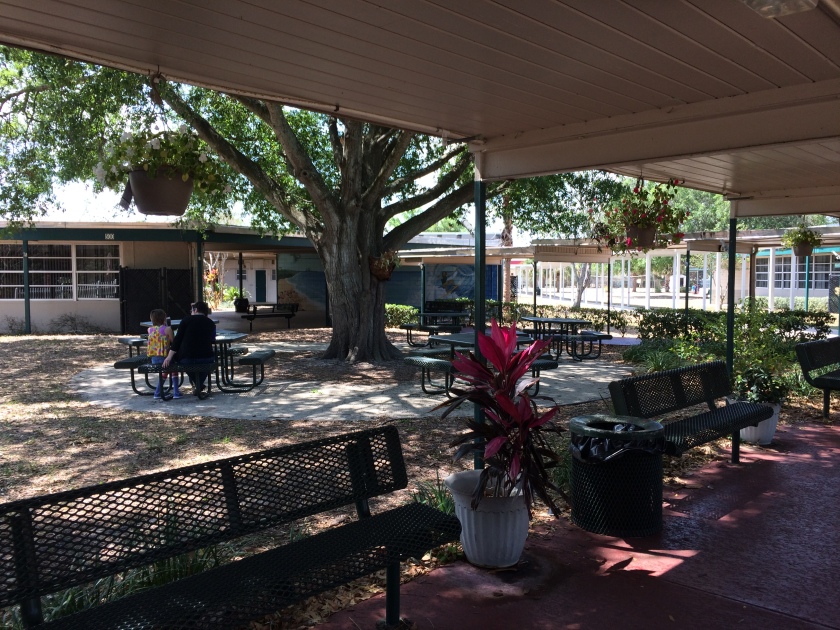 I spoke with Mrs. Jessica Green, who attended Dover Shores as a child, and returned as a teacher in 2005. When I asked Mrs. Green if anything about education has remained the same, she smiled and said, “until now, only the buildings of Dover Shores.”
 Mrs. Green is one example of the many fine teachers at Dover Shores. Principal, Dr. Randall Hart, values the commitment of his staff who continue to be relationship driven and put the needs of students first. “Forty percent of the instructional staff has taught at this school for ten years or longer,” Dr. Hart commented. He believes a community built on caring for one another helps retain teachers year after year.