God’s Timing

“Abraham was 100 years old when his son Isaac was born to him.” (Genesis 21:5)

When specific verses of the Bible seem to jump off the page, I feel like God wants me to pay attention. It’s almost as if He is speaking to me directly. Genesis 21:5 can be taken two ways. On  the surface, Abraham waited a long time for his wife to give birth to their promised child. On a deeper level, Abraham lived long enough to see God’s purpose for his life become reality.

Some people think once we reach our retirement years, our best days are behind us. I retired from teaching at age 60 and published my first book at 66. I’m a firm believer God’s timing is never too late! But sometimes our creative projects remain on the back burner for years.

I’ve had a picture book idea, Manatee School, in various stages of development for ten years. I’d bring the manuscript out—toss around the words, and make more revisions than I can count. In 2015 I pitched Manatee School to several editors, only to be turned down because they were looking for other genres. Eventually I rewrote the rhyming picture book into a Clubhouse Junior Magazine nonfiction article, Counting Manatees. Last year I entered my Manatee School  picture book manuscript in the 2023 Florida Tapestry Awards and won honorable mention.

Since then, the idea of publishing another book filled me with dread. I did not want to experience any more rejections, nor did I want the stress which accompanies launching another book.  That was until God spoke to me through Abraham’s story.

Abraham was 100 years old when his son Isaac was born. Biblical research shares that the “waiting” period was necessary to test Abraham’s and Sarah’s faith. When Abraham was 75, God promised him that his descendants would be a great nation. At that time Sarah was in her sixties and barren. She was well beyond child-bearing age, and laughed at the thought of being a mother.

After ten more years of waiting, Sarah decided to speed up God’s timing by making her own plan. She encouraged Abraham to sleep with her Egyptian servant, Haggai, who conceived Ishmael. But Ishmael was not the child God had promised Abraham.

When Sarah rushed ahead with her own plans, God could see the couple’s faith had not grown enough to warrant His miracle child, the one to be the carrier of the covenant. So He added another fifteen years to Sarah’s barrenness. God did not doubt himself or his promise. He knew His words would come to pass in His timing. “For the gifts and the calling of God are irrevocable.” Romans 11:29 (NASB)

God had a timeline which involved Abraham and Sarah fully trusting in Him rather than relying on human possibilities. Their faith is noted in Hebrews 11:12, “And so from this one man, and he as good as dead, came descendants as numerous as the stars in the sky and as countless as the sand on the seashore.” God wants everyone to know He is still in the miracle working business!

God sees the big picture of my life, and Manatee School is my promised child.  Like Abraham and Sarah, I have experienced a delay. Perhaps God is waiting for me to be more faithful to the work. Maybe He wants me to add something to the story to make it more relatable to children. The day after I read about Abraham and Sarah, I wrote new characters (a child and her grandfather) into the plot. I have a feeling God has not “closed the book” regarding the publication of Manatee School. Remembering Abraham helps me trust God’s timing.

If you are in the waiting stage of finishing a creative work, don’t lose sight of the finish line. Pray and ask God if you need to make any changes. Trust Him to give you the ideas and discipline you need to bring your project to fulfillment.

Poetry 101

Take yourself to a comfortable place

One without pain, loneliness, or suffering.

A quiet place

Far from the stress of living.

Center yourself

Between the future and the past

In a time called today.

Experience the gentleness of the moment

Nothing is owed,

No obligations or responsibilities.

You are riding on the crest of a wave

Carried by God’s will and no other.

In this space you discover

How to visualize.

Words fall onto the page like raindrops

One at a time

Until the deluge

All of a sudden—

the page is drenched,

and a poem is born.

Silence

Silence can mean many things

Appropriate in an elevator,

But deafening after a quarrel

Maybe we are fearful to speak

Or have nothing to say,

The truth is some thoughts

Are better left unsaid.

We avoid silence,

Yet travel miles to pursue it

God is a friend to silence*

Be still and listen.

We need to find God, and he cannot be found in noise and restlessness. God is a friend of silence. —Mother Teresa

Bees, Busyness, and the Bible

“Hello, how are you?”

“Busier than I’d like to be.”

Is this your response when you meet a friend? Everyone’s busy. In fact, our culture becomes busier every day. We’ve become a nation of multitaskers who find it difficult to wait at a stoplight without looking at our phones.

I have been busy for most of my life. Mastering the ability to multitask helped me survive the demands of my day. As an elementary teacher, I became a pro at taking attendance, listening to morning announcements, and monitoring the students simultaneously. When I arrived home from work, I helped my kids with their homework while preparing dinner. On Sunday mornings, after I sang with the worship team, I raced to help with children’s church. Sadly, I had linked my self-importance to my level of activity. The thought of too many blank spaces on my calendar made me feel unneeded. I was beyond busy…and eventually I burned out.

Retirement ushered in a major lifestyle change for me. After considering several creative interests, I decided to pursue one hobby—writing. I also decided to cut back on my volunteer work. In this season of my life, my old self tries to make me feel guilty about how happy I am.

Is all busyness bad?

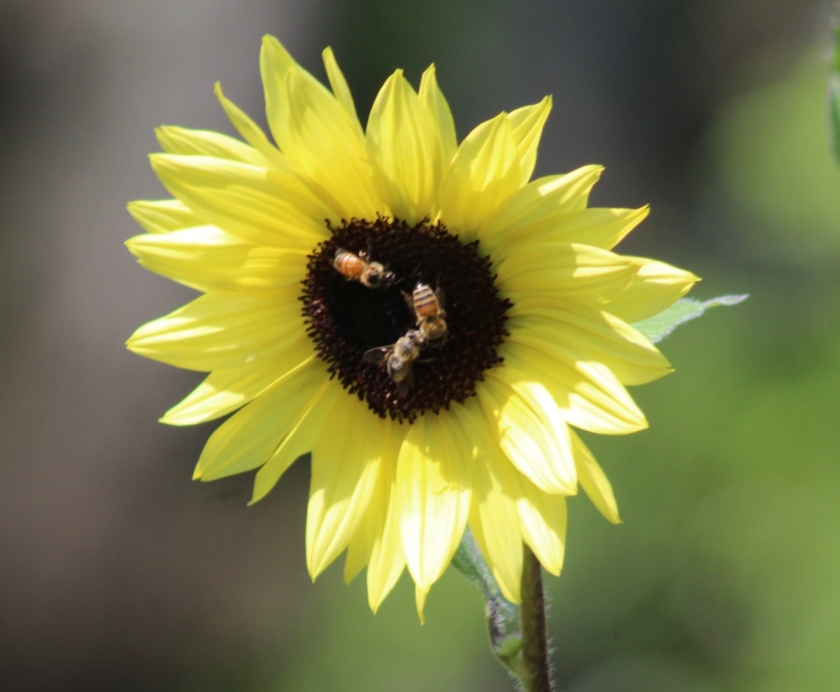
Bees are busy. They work all day flitting from flower to flower collecting pollen in order to fulfill God’s plan for their lives. I’ve never seen a stressed out bee. Like the bees, each one of us has God-given talents which He purposed for us to use. When we stray from our destiny, we flounder.

“The busyness that’s bad is not the busyness of work, but the business that works hard at the wrong things.”

—Kevin DeYoung, author of Crazy Busy.

In addition to working hard at the wrong thing, we can work for the wrong reason. In my case, compliments from others about “what a good job I was doing” encouraged me to work harder, and take on my more responsibilities. I was trying to please man more than God.

A familiar story comes to mind from Scripture. Jesus came to visit Mary and Martha. Upon his arrival, Martha was “distracted by all the preparations that had to be made.” She complained about Mary not helping her.

Jesus answered, “Martha, you are worried and upset about many things, but only one thing is needed. Mary has chosen what is better, and it will not be taken from her.” Luke 10:41,42 (NIV)

Was Martha working hard at the wrong thing? Was she working for the wrong reason? Either way, Martha had not chosen what Jesus thought was best. She busied herself with what she thought was important, instead of asking Jesus what he might want her to do. As a result, she became stressed out and resented her sister.

Have you noticed when we involve ourselves in God’s plan for our lives, we are happier, and more at peace? Work becomes a joy. Is that why the bees seem so content, buzzing while they work?

I confess I have not completely overcome my struggle with busyness. I want to tune into God’s plan and act upon the “one thing” which is needed instead of multitasking. How about you?  

Leaping Lizards!

“Ugh! Another lizard entered the house.” I pulled our sliding glass door shut, but it was too late. Herb and I live on the first floor of our apartment building, and every time we open the patio door, we invite the natural world inside.

Welcome to Florida, the epicenter of nonnative reptiles. I recognized our new guest as a brown anole. According to the University of Florida, this type of lizard hitched a ride on a shipment of cargo originating from Cuba during the late 1800’s.

Due to Florida’s warm and moist climate, the invasion of the brown anoles has expanded to every county of the peninsula. They are most common in areas dominated by humans. The little lizards can be found in school yards, gas stations, grocery stores and suburban neighborhood yards. People frequently see them on the ground and perched on tree trunks, fences, and the walls of buildings.

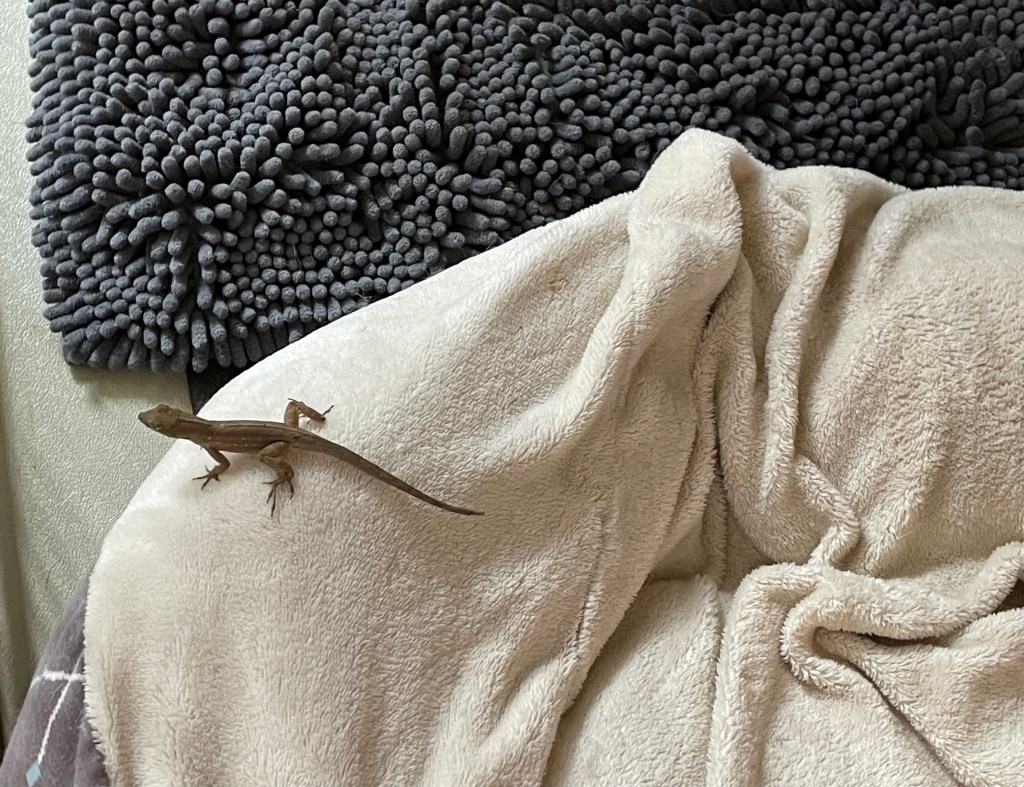
Our little invader jumped into Buddy’s dog bed which gave me an opportunity for a photo.

Isn’t he cute? I think I’ll name him Fred. My usual way of dealing with a lizard is to pick it up in a light-weight towel and release the animal outside. Unfortunately Fred was so fearful, the second I dropped the towel over him, he escaped. After ten minutes of chasing him around our apartment, I gave up.

The next morning, I spotted Fred on the floor between our sofa and end table.

I felt like he was taunting me, bobbing his head and doing little push ups with his upper body. Herb is usually able to grasp these guys with his bare hands. Fred was different. He was the fastest lizard we’d ever seen. A regular Houdini, who flattened his little body enough to slide under the couch.

When Herb and I inched the sofa away from the wall, Fred raced to the other side of the room. The chase began anew whenever we glimpsed him outside of his sofa hideout. Once we opened the patio door and tried to shoo him outside. He would have none of it. What can you do with animal who apparently has a death wish?

I read that anoles can live for a month without food but they can only live three days without water. Why was Fred still alive one week after entering our home? We could only imagine he was sneaking into the shower to lap up whatever moisture might be available.

After ten days Fred disappeared. He no longer came out from under the sofa to greet us. Someday we’ll find his dried up remains under a piece of furniture. What really killed Fred? Curiosity? Fear? Stupidity?

Not to worry. Brown anoles breed during the summer and a female lays one egg every one to two weeks. The eggs hatch about one month later. There will be plenty of Fred Juniors to carry on their invasion.

The Serious Cereus

Buzzards glide in the cloudless sky

Rock squirrels hurry on the ground

Shadowed by the prickly pear,

The Cereus makes no sound.

This lazy cactus leans upon

Support from kindly neighbors

Waiting for the perfect time

To begin its covert labors.

Once a year the sunset beckons—

And Cereus buds unfold

Their delicate white petals

With centers of soft gold.

A fragrance like vanilla

Spills forth from every core

Luring a local sphinx moth

To pollinate…before…

The first light of the morning

Forever shuts each flower

Without complaint or question,

They meet their final hour.

The secret of the Cereus

Revealed one moonlit night

Fulfill the Maker’s purpose

Inside the span of life.

Buzzards glide in the cloudless sky

Rock squirrels hurry on the ground

Life resumes in the desert heat

But the Cereus makes no sound.

Dear Reader,

“The Serious Cereus” is a revision of a poem which first appeared on my blog entitled “The Secret of the Cereus” in 2016. Check it out. I include much more information about this interesting cactus.

Quiet Time

Here I am Lord

ready to begin my day.

I confess you were not first in my routine,

never are.

First, the daily weigh-in,

before I consumed a bowl of cheerios with blueberries.

Then facebook

beckoned my attention.

I gave my friends the “likes” they deserved

before settling in my easy chair with my second cup of coffee.

After scanning a few Bible verses

and writing my requests in my “prayer journal,”

I thought I’d fulfilled my duty

and meandered outdoors for a walk.

Here at the pond

suddenly I see

in order to hear from you, I must listen.

Here I am Lord,

ready to begin our day.

I’m an Old Dog

Here I lie, in the bed I’ve made

Sunken from many naps

I chase squirrels in my dreams

And remember romps through the park with my master.

I’ve slowed down

My face, now gray with age,

My eyes are dim, and my hearing slight

But my heart is tuned to my family,

Who have met my needs these many years.

Our story began years ago

When my humans appeared at the beagle rescue…

We connected.

I think they were looking for someone like me.

Together we visit outdoor markets

Where delightful smells fill the air

And strangers love to rub my ears

Somehow everyone knows my name…

Buddy the Beagle on Blueberry Street.

Message from a Brook

Come closer, daughter

My bank has the perfect boulder waiting for you

You will find rest

When you let my endless burble speak to your busy mind

Breathe…

Lay your worries down

Give them to me

I will carry them to the depths of the sea.

I bring life to all I touch

From the towering silver maple to the tiny striped minnow

All are nourished by my abilities.

See the lush thicket?

Each fern knows me well

Rooted in my abundance,

Their lacy fronds

beam with contentment.

I am a channel of resources

An open frequency

Yet you seldom tune me in.

Come near, daughter, and sit awhile.

Dear Reader,

Hopefully my latest poem will inspire you to get outside and allow the natural world to speak to you. I want to do just that! Look for another post next week which celebrates National Poetry Month.

Exercise in OO

Sue jumped out of bed, she knew what to do.

She pulled on her jeans and shouted, “yahoo!”

“I’ve got the day off, so I’ll visit to the zoo.”

The gates had just opened, the visitors few.

“Hello,” Sue smiled to the grounds-keeping crew.

“You do a great job, this place looks brand new.”

Inside the birdhouse Sue’s interest grew.

High overhead her feathered friends flew.

A rainbow of colors, some red, and some blue.

Then a strange voice rose above every coo.

“Hello pretty lady, how do you do?”

Sue parted the foliage, only to view.

Perched on a limb sat a fat cock-a-too.

Dear Reader,

I had fun writing this poem. After finishing “Exercise in OO” I realized there are countless possibilities poets have at their disposal. Poetry can be serious or fun. I tapped into the idea from a resource: “5-Minute Daily Writing Prompts” by Tarn Wilson. Begin by listing all the words you can think of which contain the same vowel sound. (This is very easy if you have a rhyming dictionary.) Then you start putting the words into lines to create a poem.

By the way, April is National Poetry month. Look for another poem from me next week.