Going Batty in Baldwin Park

Floridians love the sunshine and the beach, but we all know there are trade-offs to living here. In the summer we not only endure humidity and storms—we also endure living with bats. As someone who has lived in the Orlando neighborhood of Baldwin Park, I have first hand knowledge of these flying furry animals.

Bats are drawn to the natural environment around Lake Baldwin. Animals migrate to find food, and bats take no exception. Summer temperatures in the mid-nineties and frequent rainstorms make Florida the perfect environment for mosquitos, and bats love to eat mosquitos. That’s a good thing right?

It’s good until bats take up residence in your house. The pitched roofs of many Baldwin Park homes invite bats to roost in the attic by squeezing through any opening they might find. Recently a Baldwin Park homeowner told me he heard a strange sound in his living room. The next morning he discovered a bat on the floor of the dining room. It was still alive, but could not raise itself to fly. Quick thinking, he captured the animal in a pool net and released it outside before any harm was done.

Later the homeowner contacted a “bat specialist” for advice, and set up an appointment for a home inspection. The specialist said it’s uncommon for a bat to enter the living area of a home, but it’s not impossible. The inspection revealed there was a colony of bats living in the attic. Since they are a protected species, it’s illegal to disturb their “roost” until August 15!

Attic Nurseries

Hearing about my neighbor’s experience prompted me to know more. My internet research informed me the Brazillian free-tailed bat is the main species found in Orlando. Their maternity season begins April 15 and ends August 15. The female bats gather in dark enclosed spaces (often in an attic) to give birth and nurse their babies. I was surprised to learn that bats are mammals. They even have a belly-button! The babies are very dependent upon their mothers until they are around eight weeks old. Then the juveniles start to find food for themselves.

August 15—Eviction Day

A few years ago bats roosted in our Baldwin Park townhome. Once I was walking our dog at sunrise, and I saw dozens of bats enter a tiny opening in the dormer above our front porch. Their guano (feces) made a nasty mess of our front steps. Throughout the month of July my husband cleaned the porch daily. On August 15, a professional installed a one-way door in the dormer, so the bats could fly out but not return. This is a humane way to eradicate bats from a building without harming them.

Are Bats Dangerous?

According to the U.S. Geological Survey, healthy bats avoid humans. Less than one percent of the bat population contracts rabies. Even so, bats should not be handled—especially those that are active during daylight hours. All bat bites should be washed immediately with soap and water and a physician should be consulted.

Bat guano is a serious health risk for homeowners. When guano exists in an attic or crawlspace, the microscopic spores can be inhaled by humans and cause a serious respiratory infection called histoplasmosis. If they eat the guano, Pets can also become infected.

Why are Bats Protected?

Over half of bat species are in serious decline due to habitat loss, climate change, and a fungal infection called white-nose syndrome. Even though bats cause problems for homeowners, we need them. They pollinate plants and devour their body weight in insects every night. Without bats we wouldn’t have bananas, avocados, and mangos. These heroes of the night are more helpful than harmful.

A Common-Sense Solution

If homeowners want to evict bats from their attics, but not leave them homeless, a bat house might work. Homeowners need to contact their HOA to learn the regulations for their neighborhood.

August 15 is almost two months from now. Until then, my neighbor will need to keep his pool net handy!
If You Build It—They Will Come.

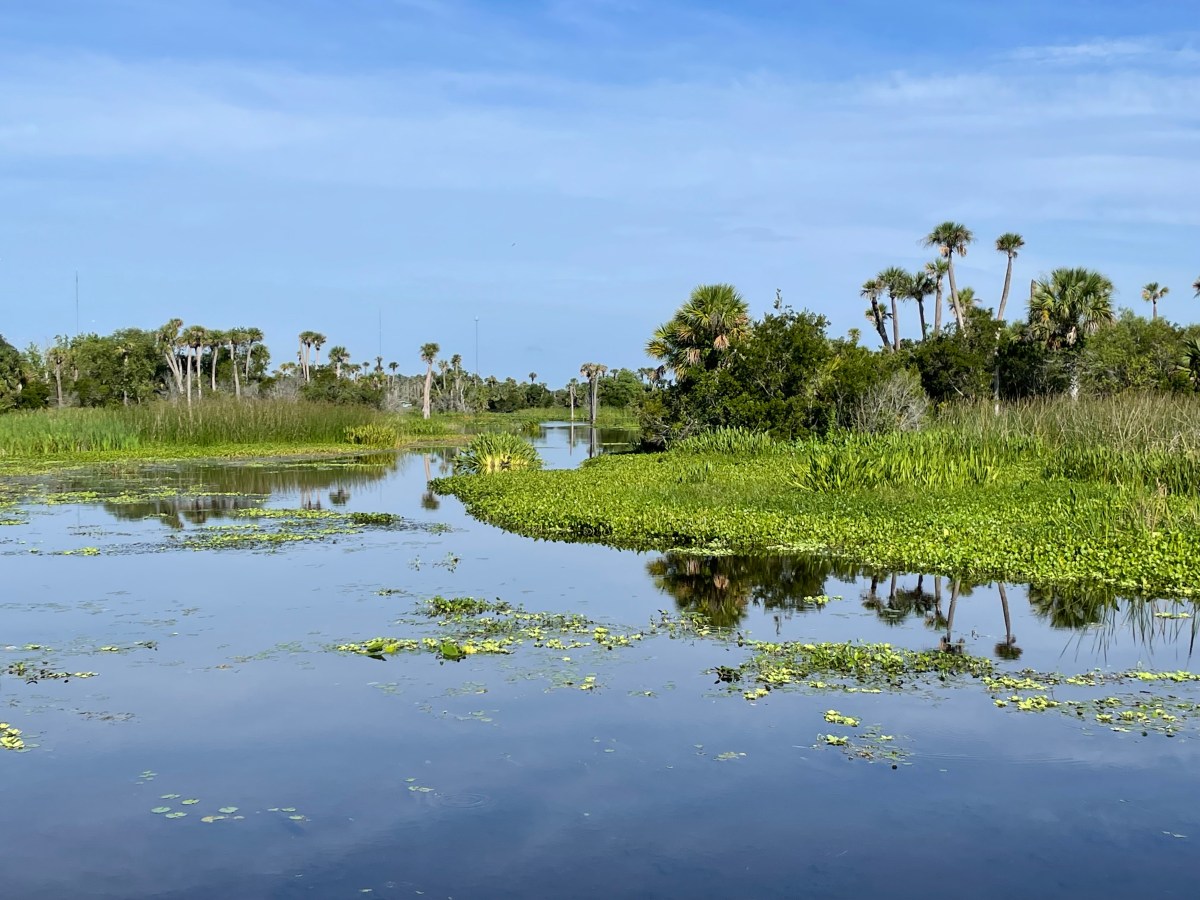
Orlando Wetlands Park provides a habitat for 220 species of birds.

Remember the 1989 movie Field of Dreams? An Iowa farmer named Ray Kinsella walks through his cornfield and hears a “voice” which says, “If you build it— he will come.” Ray responds by turning his cornfield into a baseball diamond, and creates a place for deceased players to redeem their lost opportunities to play baseball. By doing so, Kinsella sacrifices a profit from the sale of corn in order to fulfill a higher calling.

Connections can be made between this movie and other situations. The growth and development of central Florida is one example. After the Civil War, the early settlers drained the wet prairie for agricultural purposes and cattle grazing. During the 1900s the population of Orlando continued to grow, and the construction of more housing developments meant that more wetlands were drained.

The loss of Florida wetlands has had a major effect on water quality, flood control, and wildlife habitats. Wetlands filter pollutants, and play a crucial role in recharging the aquifer, a vital source of drinking water.

In 1986 city of Orlando officials heard the “voice” of the environment when they came up with an innovative solution for the disposal of reclaimed sewer water. The city purchased 1,650 acres of former pasture land and converted it to a man-made wetland near Fort Christmas. Orlando Wetlands was designed to further purify treated sewage water discharged from the Iron Bridge Water Reclamation Facility. The reclaimed water enters the southwestern edge of the property, and over a period of forty days meanders through various marshes, swamps, and Lake Searcy, before flowing into the St. Johns River.

So what does all this have to do with the Field of Dreams? Instead of attracting the ghosts of former baseball players, Orlando Wetlands attracts an abundance of living creatures. The wetlands provide a habitat for numerous animal species including otter, bobcat, deer, turtles, snakes, alligators, and over 220 species of birds. Eighteen of these species are listed as threatened, endangered, or protected. I like to think of it as an opportunity for animals to live in a place they had once been evicted from.

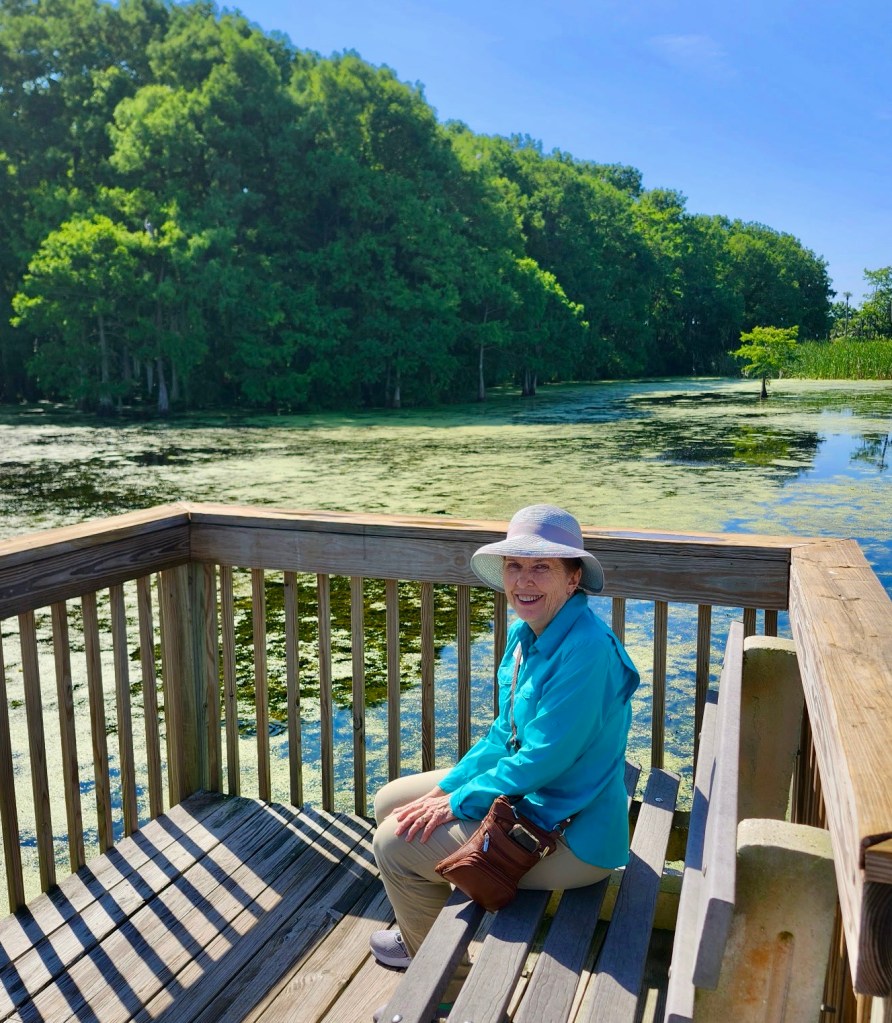
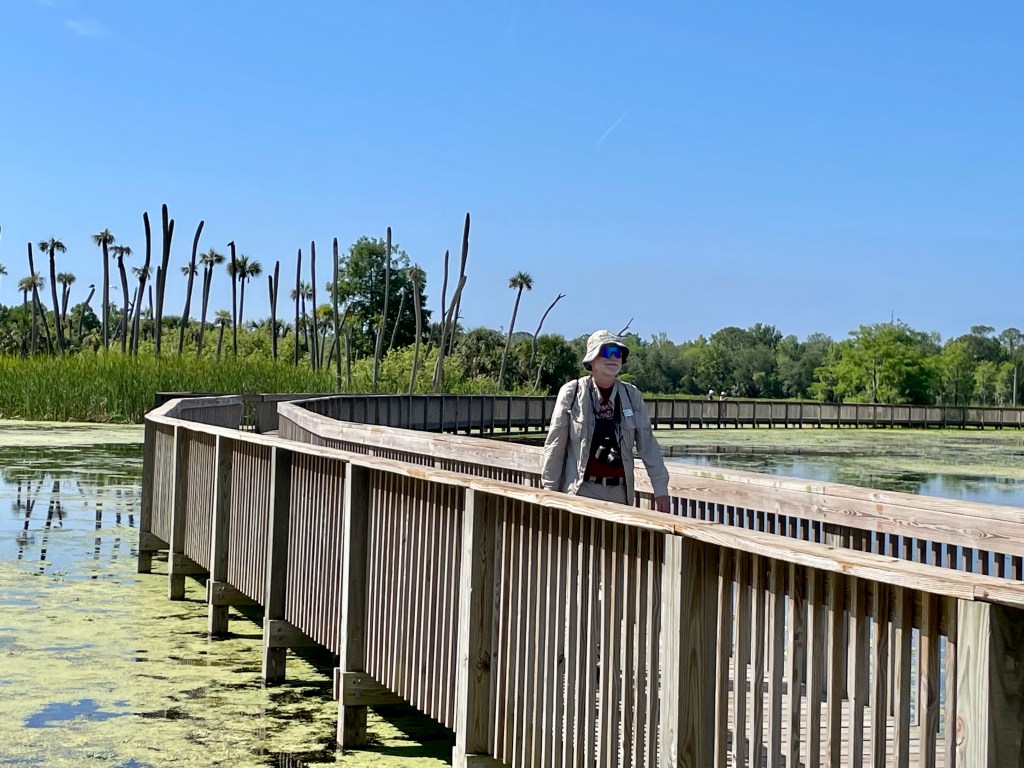
Orlando Wetlands is open to the public and admission is free. My husband, Herb, and I visited the park and walked the half-mile Cypress Boardwalk which affords close-up views of aquatic wildlife.

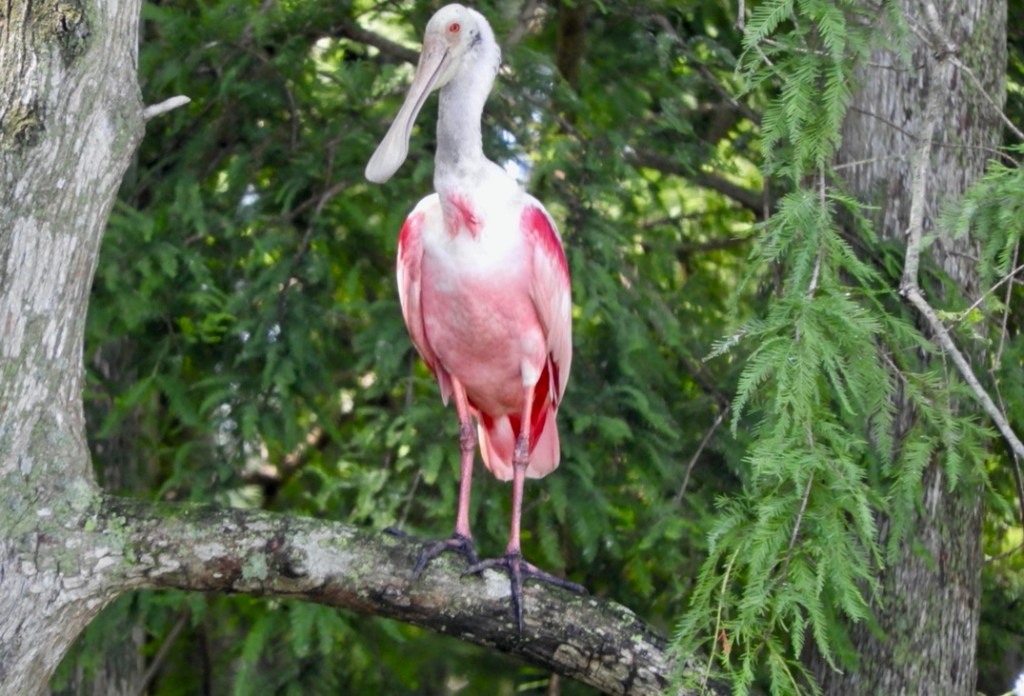
Beautiful Roseate Spoonbills roost in a grove of bald cypress trees near the boardwalk. Herb snapped this photo with his zoom lens. Did you know a baby spoonbill is called a teaspoon?

I can’t say this species is endangered. The Florida Fish and Wildlife Commission estimates there are over 1.3 million alligators in Florida.

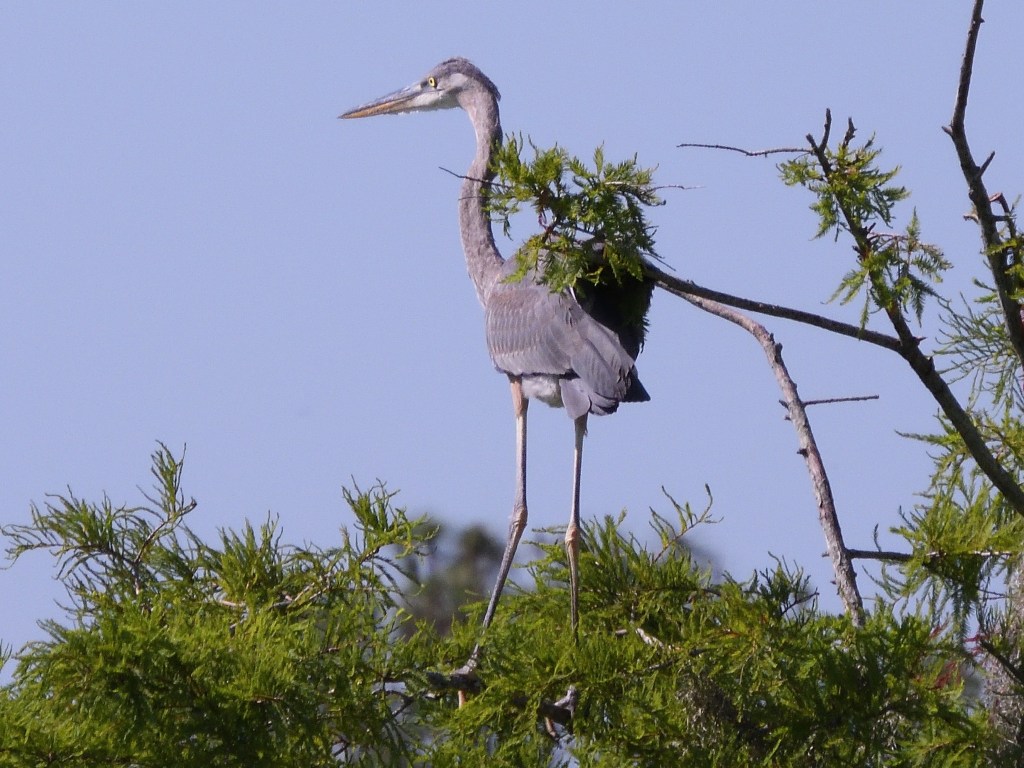
This tree top provides a place to rest for the Great Blue Heron, while allowing the bird to focus on what’s happening in the marsh below.

I’m not sure what kind of bird this is. If you can identify it, leave a comment. It makes a lot noise!

Summer is a challenging time to explore the outdoors in Florida. Wear a hat, carry water, and take breaks often. Follow the link for more information about visiting Orlando Wetlands.

Lessons from Lake Louisa State Park

Change is a fact of life, and everyone experiences loss. With that said, I will tell you my story. For several years during the fall and winter months Herb and I camped in Florida’s State Parks. We pulled a Viking camper with our Grand Cherokee, and always took Buddy, our beagle along.

In 2022 the jeep started having mechanical problems, which seemed impossible for any mechanic to diagnose. Herb didn’t think it would be safe to pull the camper, so we decided to sell it and the jeep, and buy a new SUV.

Since then, I’ve really missed going camping, especially when the temperatures drop in the fall. One day I remembered some of the parks have cabins for rent. The cabins have a “no pet policy,” so we hadn’t entertained the idea until now. Sadly, Buddy is no longer with us—which had the effect of plunging me into a no writing zone for the last two months.

When I discovered a cabin was available at Lake Louisa State Park, I booked it. The park is located only thirty miles west of Orlando.

Our cabin included a large living room, and a full kitchen. Everything was clean and comfortable. I could sit on the front porch overlooking the lake and write. What a delight to see the sun’s rays glisten upon every blade and leaf. I loved hearing squirrels chatter in a nearby tree, and birds squawk in the grass below me. What a gift to be in God’s creation again!

This was a different trip, without a camper or a dog, but it taught me God has the power to redeem my losses. I am reminded of the story of Naomi in the Old Testament. While living in a foreign land called Moab, Naomi had lost her husband, and both of her sons. She decided to return back home to Bethlehem. Although her daughter-in-law, Ruth, was a Moabite, she insisted on going with Naomi. Ruth denied her own culture when she said, “Where you go I will go, and where you stay, I will stay. Your people will be my people, and your God my God.” (Ruth 1:16 NIV)

After Ruth arrived in Judah, she met and later married Boaz, who was one of Naomi’s in-laws. Boaz and Ruth conceived a child and blessed Naomi with a grandson, Obed. He became the father of Jesse, who became the father of King David.

Yes, God has a way of redeeming our losses and turning sadness into joy. As Herb and I hiked the trails in the park and relaxed around the campfire at night, I felt renewed in my spirit. The great outdoors is always there, and I felt so good to be in it again.

Take heart reader, if you are living with a loss, God will restore your joy in his timing.

Happy Thanksgiving!

Bees, Busyness, and the Bible

“Hello, how are you?”

“Busier than I’d like to be.”

Is this your response when you meet a friend? Everyone’s busy. In fact, our culture becomes busier every day. We’ve become a nation of multitaskers who find it difficult to wait at a stoplight without looking at our phones.

I have been busy for most of my life. Mastering the ability to multitask helped me survive the demands of my day. As an elementary teacher, I became a pro at taking attendance, listening to morning announcements, and monitoring the students simultaneously. When I arrived home from work, I helped my kids with their homework while preparing dinner. On Sunday mornings, after I sang with the worship team, I raced to help with children’s church. Sadly, I had linked my self-importance to my level of activity. The thought of too many blank spaces on my calendar made me feel unneeded. I was beyond busy…and eventually I burned out.

Retirement ushered in a major lifestyle change for me. After considering several creative interests, I decided to pursue one hobby—writing. I also decided to cut back on my volunteer work. In this season of my life, my old self tries to make me feel guilty about how happy I am.

Is all busyness bad?

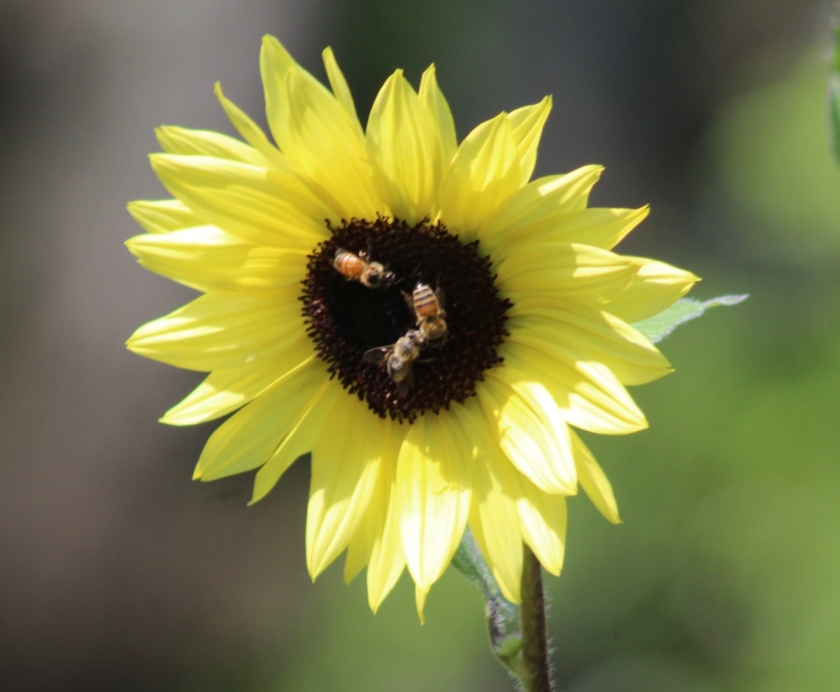
Bees are busy. They work all day flitting from flower to flower collecting pollen in order to fulfill God’s plan for their lives. I’ve never seen a stressed out bee. Like the bees, each one of us has God-given talents which He purposed for us to use. When we stray from our destiny, we flounder.

“The busyness that’s bad is not the busyness of work, but the business that works hard at the wrong things.”

—Kevin DeYoung, author of Crazy Busy.

In addition to working hard at the wrong thing, we can work for the wrong reason. In my case, compliments from others about “what a good job I was doing” encouraged me to work harder, and take on my more responsibilities. I was trying to please man more than God.

A familiar story comes to mind from Scripture. Jesus came to visit Mary and Martha. Upon his arrival, Martha was “distracted by all the preparations that had to be made.” She complained about Mary not helping her.

Jesus answered, “Martha, you are worried and upset about many things, but only one thing is needed. Mary has chosen what is better, and it will not be taken from her.” Luke 10:41,42 (NIV)

Was Martha working hard at the wrong thing? Was she working for the wrong reason? Either way, Martha had not chosen what Jesus thought was best. She busied herself with what she thought was important, instead of asking Jesus what he might want her to do. As a result, she became stressed out and resented her sister.

Have you noticed when we involve ourselves in God’s plan for our lives, we are happier, and more at peace? Work becomes a joy. Is that why the bees seem so content, buzzing while they work?

I confess I have not completely overcome my struggle with busyness. I want to tune into God’s plan and act upon the “one thing” which is needed instead of multitasking. How about you?  

Leaping Lizards!

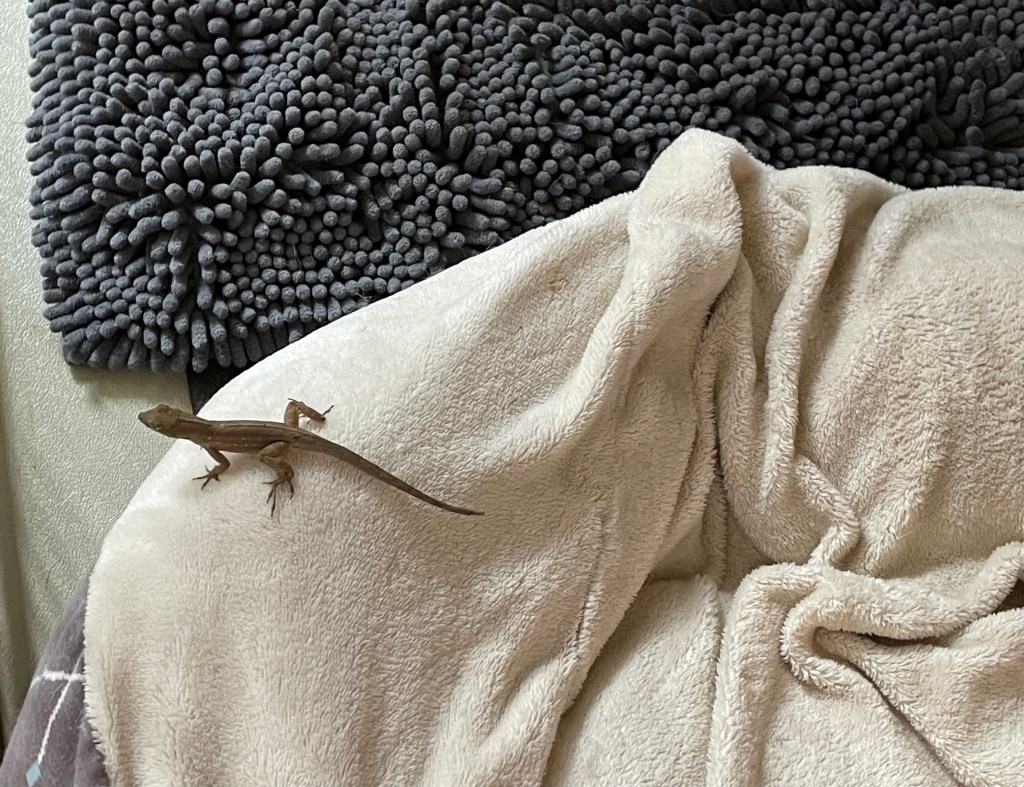
“Ugh! Another lizard entered the house.” I pulled our sliding glass door shut, but it was too late. Herb and I live on the first floor of our apartment building, and every time we open the patio door, we invite the natural world inside.

Welcome to Florida, the epicenter of nonnative reptiles. I recognized our new guest as a brown anole. According to the University of Florida, this type of lizard hitched a ride on a shipment of cargo originating from Cuba during the late 1800’s.

Due to Florida’s warm and moist climate, the invasion of the brown anoles has expanded to every county of the peninsula. They are most common in areas dominated by humans. The little lizards can be found in school yards, gas stations, grocery stores and suburban neighborhood yards. People frequently see them on the ground and perched on tree trunks, fences, and the walls of buildings.

Our little invader jumped into Buddy’s dog bed which gave me an opportunity for a photo.

Isn’t he cute? I think I’ll name him Fred. My usual way of dealing with a lizard is to pick it up in a light-weight towel and release the animal outside. Unfortunately Fred was so fearful, the second I dropped the towel over him, he escaped. After ten minutes of chasing him around our apartment, I gave up.

The next morning, I spotted Fred on the floor between our sofa and end table.

I felt like he was taunting me, bobbing his head and doing little push ups with his upper body. Herb is usually able to grasp these guys with his bare hands. Fred was different. He was the fastest lizard we’d ever seen. A regular Houdini, who flattened his little body enough to slide under the couch.

When Herb and I inched the sofa away from the wall, Fred raced to the other side of the room. The chase began anew whenever we glimpsed him outside of his sofa hideout. Once we opened the patio door and tried to shoo him outside. He would have none of it. What can you do with animal who apparently has a death wish?

I read that anoles can live for a month without food but they can only live three days without water. Why was Fred still alive one week after entering our home? We could only imagine he was sneaking into the shower to lap up whatever moisture might be available.

After ten days Fred disappeared. He no longer came out from under the sofa to greet us. Someday we’ll find his dried up remains under a piece of furniture. What really killed Fred? Curiosity? Fear? Stupidity?

Not to worry. Brown anoles breed during the summer and a female lays one egg every one to two weeks. The eggs hatch about one month later. There will be plenty of Fred Juniors to carry on their invasion.

The Serious Cereus

Buzzards glide in the cloudless sky

Rock squirrels hurry on the ground

Shadowed by the prickly pear,

The Cereus makes no sound.

This lazy cactus leans upon

Support from kindly neighbors

Waiting for the perfect time

To begin its covert labors.

Once a year the sunset beckons—

And Cereus buds unfold

Their delicate white petals

With centers of soft gold.

A fragrance like vanilla

Spills forth from every core

Luring a local sphinx moth

To pollinate…before…

The first light of the morning

Forever shuts each flower

Without complaint or question,

They meet their final hour.

The secret of the Cereus

Revealed one moonlit night

Fulfill the Maker’s purpose

Inside the span of life.

Buzzards glide in the cloudless sky

Rock squirrels hurry on the ground

Life resumes in the desert heat

But the Cereus makes no sound.

Dear Reader,

“The Serious Cereus” is a revision of a poem which first appeared on my blog entitled “The Secret of the Cereus” in 2016. Check it out. I include much more information about this interesting cactus.

Quiet Time

Here I am Lord

ready to begin my day.

I confess you were not first in my routine,

never are.

First, the daily weigh-in,

before I consumed a bowl of cheerios with blueberries.

Then facebook

beckoned my attention.

I gave my friends the “likes” they deserved

before settling in my easy chair with my second cup of coffee.

After scanning a few Bible verses

and writing my requests in my “prayer journal,”

I thought I’d fulfilled my duty

and meandered outdoors for a walk.

Here at the pond

suddenly I see

in order to hear from you, I must listen.

Here I am Lord,

ready to begin our day.

Message from a Brook

Come closer, daughter

My bank has the perfect boulder waiting for you

You will find rest

When you let my endless burble speak to your busy mind

Breathe…

Lay your worries down

Give them to me

I will carry them to the depths of the sea.

I bring life to all I touch

From the towering silver maple to the tiny striped minnow

All are nourished by my abilities.

See the lush thicket?

Each fern knows me well

Rooted in my abundance,

Their lacy fronds

beam with contentment.

I am a channel of resources

An open frequency

Yet you seldom tune me in.

Come near, daughter, and sit awhile.

Dear Reader,

Hopefully my latest poem will inspire you to get outside and allow the natural world to speak to you. I want to do just that! Look for another post next week which celebrates National Poetry Month.

Lessons from Ground Hog Day

Ah… We can all breathe a sigh of relief. Spring is predicted to arrive early this year because Punxsutawney Phil did not see his shadow. For 138 years thousands of people have gathered at Gobbler’s Knob to see a ground hog predict the weather. Today’s news inspired me to “dig” around for a little more information.

Why February 2?

This date is halfway between the Winter Solstice (December 21) and Spring Equinox. (March 21)

How did Ground Hog Day begin?

The custom of using rodents to predict the weather was brought to the U.S. by German immigrants. The first celebration was held on February 2, 1877 at Gobbler’s Knob in Punxsutawney, Pennsylvania. That’s when newspaper editor Clymer Freas and his groundhog hunting club designated Punxsutawney Phil as the nation’s official rodent meteorologist.

Today a group called the “Inner Circle” treks to Gobbler’s Knob every year to play a part in the staging of Phil’s announcement. They dress in black suits, top hats, and speak Pennyslvania Dutch dialect.

The high point of the ceremony is when Phil emerges from his burrow and talks to the the “Inner Circle” president in “Groundhogese.” This language is only understood by the president of the club, who translates the message into English.

How accurate is Phil?

According to data supplied by NOAA and the Stormfax Almanac, Phil has been right 39% of the time. However, he did not show up at all in 1943 and no one knows why.

Art Inspired by Nature

February 2 reminds me of the movie “Ground Hog Day. “ (1993) Bill Murray plays the part of Phil Connors, a weather man who is assigned to report on the celebration in Punxsutawney. He hates his job, his colleagues, and the human race. Stuck in a time-warp, Phil is doomed to repeat Ground Hog Day until he learns how to love.

What if Punxsutawney Phil sees his shadow? Are we condemned to live with perpetual winter for six more weeks? I don’t believe in rodent predictions. It’s hard enough to believe the day to day weather report.

Even so, I do believe attitude is everything. Like a hamster on a wheel, I can be stuck going nowhere. Life has no meaning without love. Ground Hog Day prompts me to appreciate the value of my relationships and enjoy every moment, of every season.

By the way, Valentine’s Day is coming soon.

Gray Skies

over my head

a mysterious forecast hangs in the balance

uncommitted to rain or sun

plagued with a loss of vibrancy

dull, heavy, and fixed

beyond my reach.

Then I remember,

my captain orders the seasons

He quiets my spirit and takes me

where peace abounds…

among the barren and stunted blades.

Dear Readers, I am writing to you from the “Sunshine State,” only the sun seems to have disappeared. In these bleak January days, may you sense God’s love for you in spite of the weather. Remember, He is always in control.

Inspired by: “He speaks to the sun and it does not shine: he seals off the light of the stars.” Job 9:7 NIV