Microwave Dependency

Last week our built-in microwave oven broke. Since we live in an apartment community for retired seniors, most repairs are the duty of the maintenance department. Within a few hours our maintenance man, whose name is Radar, (no pun intended) showed up and examined the appliance. “Yep,” he said, “This oven is broke. I’ll put in an order, but it will take three weeks to get another one.”

“You’ve got to be kidding,” I thought to myself. “How can we survive?” My thoughts raced as I imagined an average day in our kitchen. My husband uses the microwave to make instant oatmeal for breakfast. Our granddaughter loves microwavable macaroni and cheese when she visits us for lunch. Every afternoon I heat a cup of water for tea. And how will we prepare the standard bag of popcorn in the evening while we watch a movie? At this point in my life I honestly don’t know how to make popcorn any other way.

The microwave dilemma influences the choices I make at the grocery store. Today as I pushed my cart through the frozen food aisle, I noticed Healthy Choice frozen meals were a BOGO. I paused for a minute, then realized I wouldn’t be able to cook them.  I could store the meals in the freezer but it’s already full of frozen vegetables, which by the way, I usually cook in the microwave. I sighed and proceeded to the checkout thinking, “With this wave of modern convenience I have been greatly inconvenienced!”

Who is responsible for my dependency? None other than self-taught engineer, Percy Spencer. As an employee of Raytheon Laboratories during World War II, Spencer noticed a candy bar had melted in his pocket while working with a live radar set emitting microwave signals. He accidentally discovered the radar’s compact cavity magnetron tube generated heat.

Spencer experimented with heating foods by directing the magnetron tube toward popcorn and eggs. That must have been messy until he created a metal box to contain the magnetron tube. Once the box was created, a rough model of the first microwave oven was patented by Spencer in 1945. Surprisingly, Mr. Spencer only received a $2.00 bonus for his invention, and never collected any royalties.

The early appliances were huge, practically the size of a refrigerator, and expensive—costing $5,000 each, so initially microwaves were used only by industrial kitchens. In 1967 a residential countertop model was manufactured by the Amana Corporation and sold for under $500. During the 1970’s cheaper parts and advancements brought prices down. Today microwave ovens are considered a standard built-in feature in most American kitchens and have transformed modern cooking. 

Our microwave was brand new when we moved into our apartment in 2021. Wouldn’t you think it would last longer than three years? An old saying rings true, “they just don’t make things like they used to.”

As far as my microwave dependency I guess we’ll have “cold turkey” for dinner tonight.

The Allure of “Alone”

My favorite television program is “Alone.” If you’ve never seen it, ten individuals compete in a contest for a prize of $500,000. Each contestant camps alone on a tract of land. The object of the contest is to survive living in the wilderness by relying on their own skills. Most of the programs I’ve watched take place in northern Canada during the late fall and winter. The contestants are permitted to bring ten items which can be used to construct shelter and procure food. Every contender is supplied with cameras to film their experiences.

I like the show because the producers choose beautiful wild settings for the contest. As a viewer, and someone who enjoys the outdoors, I feel drawn into their world when I hear the rustle of leaves and rippling water. I imagine the fragrance of the pines and the smoke of the campfire.

Each episode follows the various characters through their struggle to survive. Some people decide to build a shelter right away while others decide finding food is their first priority. Each setting includes access to a lake. In order to insure it is free from bacteria, the water must be boiled.

Contestants collect edible plants, fish, and hunt for food with primitive tools. Guns are not permitted. After a successful catch or kill, the meat is sometimes stored for future use. This too, is a challenge, since food caches draw scavengers like pine martins, bears, and wolves. The contest is not only among contestants, but with nature itself.

Anytime during the contest a participant can “tap out” by using a special phone. Some contestants tap out after a few days due to injury or illness. Gastro-intestinal issues are common when a person eats something deadly. I would not enjoy eating some of the animals the contestants eat. But if you’re hungry, anything’s game! The last man or woman standing earns the prize money. I have watched episodes where the winner of the contest survived for 80 days.

The real test for every contestant is overcoming loneliness. Everyone misses their family members. Some contestants focus on winning the money and how they plan to spend it. This goal keeps them going for awhile, but loneliness eventually consumes even the most introverted person. Some contestants have created dolls and statues to talk to. Everyone talks to the camera, because eventually the show will be produced and their loved ones will watch. The contestants pretend they are actually talking to someone—but no one talks back.

One contender remarked that that he understood why prisons use solitary confinement to punish people. It is difficult to be alone with your own thoughts and stay positive. Love is a force which empowers humans to live. Relationships change our objective from physical survival to living for a higher purpose. In addition, working cooperatively can accomplish more in less time.

The author of Ecclesiastes speaks to the benefit of friendship. “Two are better than one, because they have good return for their work. If one falls down, his friend can help him up. But pity the man who falls down and has no one to help him up.” Eccl. 4:9 NIV

The contestants on “Alone” are allured by an idea of rugged individualism. But each season of the show teaches the same lesson. People need people. The program makes me appreciate the life I live, and my relationships which make life meaningful.

When I compare my outdoor skills with these survival experts I know I wouldn’t stand a chance of lasting more than one night. What would you miss most?

Lessons from Lake Louisa State Park

Change is a fact of life, and everyone experiences loss. With that said, I will tell you my story. For several years during the fall and winter months Herb and I camped in Florida’s State Parks. We pulled a Viking camper with our Grand Cherokee, and always took Buddy, our beagle along.

In 2022 the jeep started having mechanical problems, which seemed impossible for any mechanic to diagnose. Herb didn’t think it would be safe to pull the camper, so we decided to sell it and the jeep, and buy a new SUV.

Since then, I’ve really missed going camping, especially when the temperatures drop in the fall. One day I remembered some of the parks have cabins for rent. The cabins have a “no pet policy,” so we hadn’t entertained the idea until now. Sadly, Buddy is no longer with us—which had the effect of plunging me into a no writing zone for the last two months.

When I discovered a cabin was available at Lake Louisa State Park, I booked it. The park is located only thirty miles west of Orlando.

Our cabin included a large living room, and a full kitchen. Everything was clean and comfortable. I could sit on the front porch overlooking the lake and write. What a delight to see the sun’s rays glisten upon every blade and leaf. I loved hearing squirrels chatter in a nearby tree, and birds squawk in the grass below me. What a gift to be in God’s creation again!

This was a different trip, without a camper or a dog, but it taught me God has the power to redeem my losses. I am reminded of the story of Naomi in the Old Testament. While living in a foreign land called Moab, Naomi had lost her husband, and both of her sons. She decided to return back home to Bethlehem. Although her daughter-in-law, Ruth, was a Moabite, she insisted on going with Naomi. Ruth denied her own culture when she said, “Where you go I will go, and where you stay, I will stay. Your people will be my people, and your God my God.” (Ruth 1:16 NIV)

After Ruth arrived in Judah, she met and later married Boaz, who was one of Naomi’s in-laws. Boaz and Ruth conceived a child and blessed Naomi with a grandson, Obed. He became the father of Jesse, who became the father of King David.

Yes, God has a way of redeeming our losses and turning sadness into joy. As Herb and I hiked the trails in the park and relaxed around the campfire at night, I felt renewed in my spirit. The great outdoors is always there, and I felt so good to be in it again.

Take heart reader, if you are living with a loss, God will restore your joy in his timing.

Happy Thanksgiving!

God’s Timing

“Abraham was 100 years old when his son Isaac was born to him.” (Genesis 21:5)

When specific verses of the Bible seem to jump off the page, I feel like God wants me to pay attention. It’s almost as if He is speaking to me directly. Genesis 21:5 can be taken two ways. On  the surface, Abraham waited a long time for his wife to give birth to their promised child. On a deeper level, Abraham lived long enough to see God’s purpose for his life become reality.

Some people think once we reach our retirement years, our best days are behind us. I retired from teaching at age 60 and published my first book at 66. I’m a firm believer God’s timing is never too late! But sometimes our creative projects remain on the back burner for years.

I’ve had a picture book idea, Manatee School, in various stages of development for ten years. I’d bring the manuscript out—toss around the words, and make more revisions than I can count. In 2015 I pitched Manatee School to several editors, only to be turned down because they were looking for other genres. Eventually I rewrote the rhyming picture book into a Clubhouse Junior Magazine nonfiction article, Counting Manatees. Last year I entered my Manatee School  picture book manuscript in the 2023 Florida Tapestry Awards and won honorable mention.

Since then, the idea of publishing another book filled me with dread. I did not want to experience any more rejections, nor did I want the stress which accompanies launching another book.  That was until God spoke to me through Abraham’s story.

Abraham was 100 years old when his son Isaac was born. Biblical research shares that the “waiting” period was necessary to test Abraham’s and Sarah’s faith. When Abraham was 75, God promised him that his descendants would be a great nation. At that time Sarah was in her sixties and barren. She was well beyond child-bearing age, and laughed at the thought of being a mother.

After ten more years of waiting, Sarah decided to speed up God’s timing by making her own plan. She encouraged Abraham to sleep with her Egyptian servant, Haggai, who conceived Ishmael. But Ishmael was not the child God had promised Abraham.

When Sarah rushed ahead with her own plans, God could see the couple’s faith had not grown enough to warrant His miracle child, the one to be the carrier of the covenant. So He added another fifteen years to Sarah’s barrenness. God did not doubt himself or his promise. He knew His words would come to pass in His timing. “For the gifts and the calling of God are irrevocable.” Romans 11:29 (NASB)

God had a timeline which involved Abraham and Sarah fully trusting in Him rather than relying on human possibilities. Their faith is noted in Hebrews 11:12, “And so from this one man, and he as good as dead, came descendants as numerous as the stars in the sky and as countless as the sand on the seashore.” God wants everyone to know He is still in the miracle working business!

God sees the big picture of my life, and Manatee School is my promised child.  Like Abraham and Sarah, I have experienced a delay. Perhaps God is waiting for me to be more faithful to the work. Maybe He wants me to add something to the story to make it more relatable to children. The day after I read about Abraham and Sarah, I wrote new characters (a child and her grandfather) into the plot. I have a feeling God has not “closed the book” regarding the publication of Manatee School. Remembering Abraham helps me trust God’s timing.

If you are in the waiting stage of finishing a creative work, don’t lose sight of the finish line. Pray and ask God if you need to make any changes. Trust Him to give you the ideas and discipline you need to bring your project to fulfillment.

Unfailing Hope

Like most people I’ve had my share of ups and downs. Last year a fractured metatarsal in my left foot impaired my ability to walk for several months. During my recovery I spent a lot of time reading and discovered a volume of Emily Dickinson Collected Poems published by Fall River Press. Since poetry invites interpretation by the reader, I want to share my thoughts about one of my favorites, “Hope is a Thing with Feathers.” Emily Dickinson penned this work in 1861.

Hope is a thing with feathers

That perches in the soul

And sings the tune without the words,

And never stops at all,

And sweetest in the gale is heard;

And sore must be the storm

That could abash the little bird

That kept so many warm.

I’ve heard it in the chillest land,

And on the strangest sea,

Yet never in extremity,

It asked a crumb of me.

This poem encouraged me to never lose hope that I would someday walk again without pain. Today I’ve recovered from my injury, and Emily Dickinson’s words still speak to my spirit. As an optimist, I connect with the theme of hope. But her words also challenge me to think.

I wonder why she chose a little bird as a metaphor for hope. Birds take flight when they sense danger. They migrate to avoid harsh weather. Birds seem unsettled and fragile in comparison with other animals. But the bird in the poem is not flying. Instead it’s perched in a person’s soul singing a tune which never ends. Could its song be one of praise to its creator?

The bird’s song of hope warms those who live in cold and lonely places. Although the little bird is fragile, its tune can keep people alive during the fiercest storm. Since I live in Florida, I think of hurricane survivors who rebuild their community after a storm. They hear the song of hope which renders a power of resiliency not easy to understand.

The Oxford Language Dictionary defines hope as a feeling of expectation and desire for a certain thing to happen. The Bible goes beyond the dictionary and describes hope as what people look for God to do. Hope goes beyond a wish, to a confident expectation in God’s ability to meet a need.

Dickinson describes the little bird as asking for nothing, not even a crumb. It doesn’t cost a penny to be optimistic. Hope holds much value to people who rely on its power because it lifts their spirits. We’ve all heard stories of people who have survived unsurmountable circumstances because they did not give up. Their stories encourages us, no matter what obstacles we’re facing.

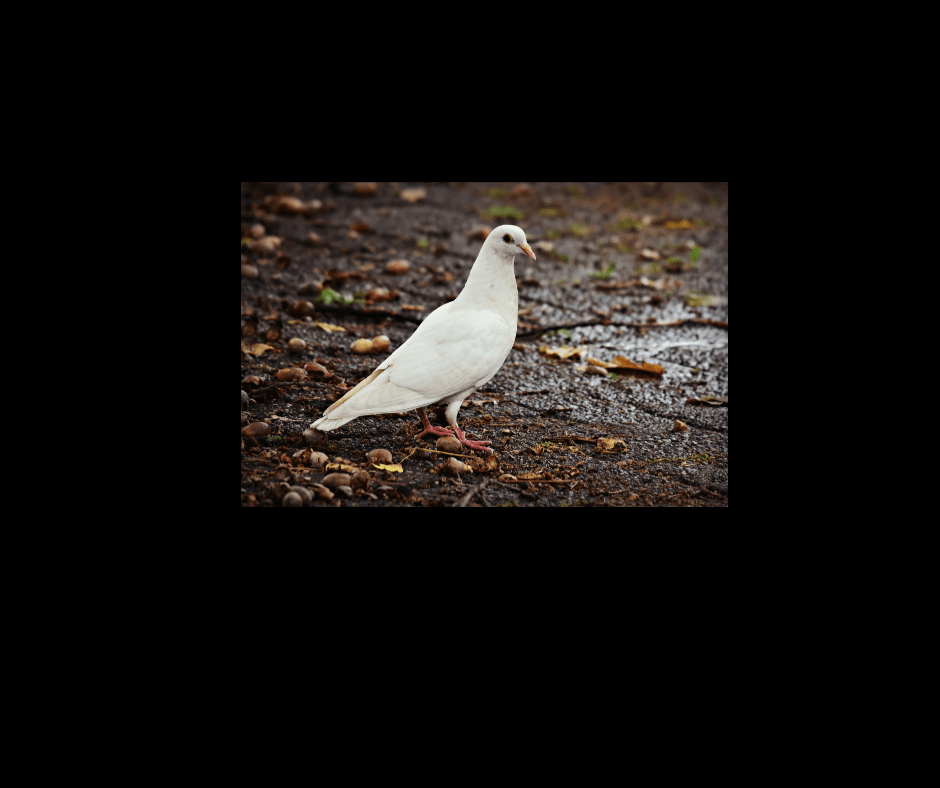
Let’s come back to the little bird in the poem. Could the bird be a dove? The Old Testament relates that after the Flood, Noah sent a dove from the ark to find land. The dove returned with an olive branch in its beak. Then Noah knew the water had receded from the earth. (Genesis 8:10-12 NIV) Can you imagine the hopefulness Noah must have felt?

The dove appears again in the New Testament. All four gospels communicate that the Holy Spirit took the form of a dove and was seen at Jesus’ baptism. Here the dove symbolizes the holiness with which Jesus was endowed. His sacrificial death for our sins brought reconciliation with God to everyone who believes.

When Jesus sent his disciples into various towns he said, “Behold, I send you out as sheep in the midst of wolves. Therefore be wise as serpents and harmless as doves.” (Matthew 10:16 NKJV) Like the feathered thing in Dickinson’s poem, doves are harmless creatures. When housed in a soul however, the dove emanates courageous hope.

Hope is a gift from God to those who seek HIm. Perhaps hope does make one demand. It asks us to trust in God. “May the God of hope fill you with all joy and peace as you trust in him, so that you may overflow with hope, by the power of the Holy Spirit.” (Romans 15:13 NIV)

Poetry 101

Take yourself to a comfortable place

One without pain, loneliness, or suffering.

A quiet place

Far from the stress of living.

Center yourself

Between the future and the past

In a time called today.

Experience the gentleness of the moment

Nothing is owed,

No obligations or responsibilities.

You are riding on the crest of a wave

Carried by God’s will and no other.

In this space you discover

How to visualize.

Words fall onto the page like raindrops

One at a time

Until the deluge

All of a sudden—

the page is drenched,

and a poem is born.

The Power of Lists

Have you ever stopped to think about how many lists there are in the world? I’ll begin by listing a few of them.

  • to-do-list
  • reading list
  • guest list
  • wait list
  • class list
  • wish list
  • bucket list
  • grocery list
  • packing list
  • FBI most wanted list….

This week I’m packing for a trip, so I made a list of everything I want to take with me. This method is not entirely fool-proof, but it helps. I wonder about people who literally, “fly by the seat of their pants,” and wait until the last minute to pack. Making a list is not for them. I’ve had experiences with family members who don’t pack enough clothes, and are forced to visit gift stores when they need a clean shirt.

A list helps me remember things. As I age, writing things down gives me a sense of security and organization. Yes, I’m one of those people who makes a weekly menu and writes down all of the items I need from the grocery. One time I lost my grocery list at the store. A feeling of panic flooded my mind and I wondered how I could function. After taking a deep breath, I realized I usually need the same staples every time I shop. Strolling through each aisle stimulated my memory. “Ok… cereal, fruit, milk, bread, turkey… (I think we’ll survive.)”

What about to-do-lists? Do you enjoy a sense of accomplishment as you complete each task and check it off the list? Too often I write too many tasks and need to carry them over to the next day, or maybe even the next week. Making and keeping lists can be time consuming and leave you depressed if you don’t accomplish what you set out to do.

What’s the point of having your whole day crossed out before you go to bed? Extend that to crossing out weeks, months, years, and even your whole life. To-do-lists are mostly for boring, unpleasant tasks that no one really wants to do. Some of the most memorable moments of our lives happen in between the entries on our list. Who writes down, “eat ice cream today,” or “sit on the front porch and enjoy the sunset?”

Speaking of enjoying life, many people write bucket lists which include exotic places to visit and adventurous activities. I’m curious, do most people write their bucket list in one sitting, or do they continually add to it? For the unimaginative, see the 55 Best Bucket List Ideas to Help you Live your Life to the Fullest.  

According to psychotherapist Karen Balumba-Bennett, people who are intentional about writing down their goals are more likely to reach them. Some bucket list ideas require time, money, and travel but there are plenty of simple things you can accomplish at home. By the way, I noticed one idea on the list is “watch the sunrise.”

Bucket lists should facilitate getting more out of life and not fulfilling duties. Balumba-Bennett believes in allowing yourself the flexibility to alter your list from year to year if your goals change. A bucket list is a way to reward yourself by doing what you really want to do.

My suitcase is packed, and I’m ready to check off another bucket list item. Vacation is calling…

Silence

Silence can mean many things

Appropriate in an elevator,

But deafening after a quarrel

Maybe we are fearful to speak

Or have nothing to say,

The truth is some thoughts

Are better left unsaid.

We avoid silence,

Yet travel miles to pursue it

God is a friend to silence*

Be still and listen.

We need to find God, and he cannot be found in noise and restlessness. God is a friend of silence. —Mother Teresa

Bees, Busyness, and the Bible

“Hello, how are you?”

“Busier than I’d like to be.”

Is this your response when you meet a friend? Everyone’s busy. In fact, our culture becomes busier every day. We’ve become a nation of multitaskers who find it difficult to wait at a stoplight without looking at our phones.

I have been busy for most of my life. Mastering the ability to multitask helped me survive the demands of my day. As an elementary teacher, I became a pro at taking attendance, listening to morning announcements, and monitoring the students simultaneously. When I arrived home from work, I helped my kids with their homework while preparing dinner. On Sunday mornings, after I sang with the worship team, I raced to help with children’s church. Sadly, I had linked my self-importance to my level of activity. The thought of too many blank spaces on my calendar made me feel unneeded. I was beyond busy…and eventually I burned out.

Retirement ushered in a major lifestyle change for me. After considering several creative interests, I decided to pursue one hobby—writing. I also decided to cut back on my volunteer work. In this season of my life, my old self tries to make me feel guilty about how happy I am.

Is all busyness bad?

Bees are busy. They work all day flitting from flower to flower collecting pollen in order to fulfill God’s plan for their lives. I’ve never seen a stressed out bee. Like the bees, each one of us has God-given talents which He purposed for us to use. When we stray from our destiny, we flounder.

“The busyness that’s bad is not the busyness of work, but the business that works hard at the wrong things.”

—Kevin DeYoung, author of Crazy Busy.

In addition to working hard at the wrong thing, we can work for the wrong reason. In my case, compliments from others about “what a good job I was doing” encouraged me to work harder, and take on my more responsibilities. I was trying to please man more than God.

A familiar story comes to mind from Scripture. Jesus came to visit Mary and Martha. Upon his arrival, Martha was “distracted by all the preparations that had to be made.” She complained about Mary not helping her.

Jesus answered, “Martha, you are worried and upset about many things, but only one thing is needed. Mary has chosen what is better, and it will not be taken from her.” Luke 10:41,42 (NIV)

Was Martha working hard at the wrong thing? Was she working for the wrong reason? Either way, Martha had not chosen what Jesus thought was best. She busied herself with what she thought was important, instead of asking Jesus what he might want her to do. As a result, she became stressed out and resented her sister.

Have you noticed when we involve ourselves in God’s plan for our lives, we are happier, and more at peace? Work becomes a joy. Is that why the bees seem so content, buzzing while they work?

I confess I have not completely overcome my struggle with busyness. I want to tune into God’s plan and act upon the “one thing” which is needed instead of multitasking. How about you?  

Leaping Lizards!

“Ugh! Another lizard entered the house.” I pulled our sliding glass door shut, but it was too late. Herb and I live on the first floor of our apartment building, and every time we open the patio door, we invite the natural world inside.

Welcome to Florida, the epicenter of nonnative reptiles. I recognized our new guest as a brown anole. According to the University of Florida, this type of lizard hitched a ride on a shipment of cargo originating from Cuba during the late 1800’s.

Due to Florida’s warm and moist climate, the invasion of the brown anoles has expanded to every county of the peninsula. They are most common in areas dominated by humans. The little lizards can be found in school yards, gas stations, grocery stores and suburban neighborhood yards. People frequently see them on the ground and perched on tree trunks, fences, and the walls of buildings.

Our little invader jumped into Buddy’s dog bed which gave me an opportunity for a photo.

Isn’t he cute? I think I’ll name him Fred. My usual way of dealing with a lizard is to pick it up in a light-weight towel and release the animal outside. Unfortunately Fred was so fearful, the second I dropped the towel over him, he escaped. After ten minutes of chasing him around our apartment, I gave up.

The next morning, I spotted Fred on the floor between our sofa and end table.

I felt like he was taunting me, bobbing his head and doing little push ups with his upper body. Herb is usually able to grasp these guys with his bare hands. Fred was different. He was the fastest lizard we’d ever seen. A regular Houdini, who flattened his little body enough to slide under the couch.

When Herb and I inched the sofa away from the wall, Fred raced to the other side of the room. The chase began anew whenever we glimpsed him outside of his sofa hideout. Once we opened the patio door and tried to shoo him outside. He would have none of it. What can you do with animal who apparently has a death wish?

I read that anoles can live for a month without food but they can only live three days without water. Why was Fred still alive one week after entering our home? We could only imagine he was sneaking into the shower to lap up whatever moisture might be available.

After ten days Fred disappeared. He no longer came out from under the sofa to greet us. Someday we’ll find his dried up remains under a piece of furniture. What really killed Fred? Curiosity? Fear? Stupidity?

Not to worry. Brown anoles breed during the summer and a female lays one egg every one to two weeks. The eggs hatch about one month later. There will be plenty of Fred Juniors to carry on their invasion.